
Indiana's Unified Clerk Structure
Indiana does not divide felony, civil, family, probate, and marriage work between a district clerk and a county clerk. One Clerk of the Circuit Court serves the county's circuit, superior, and separately named probate courts. The office is commonly branded as the “[County] County Clerk,” but the constitutional title explains its court role. This locally elected clerk preserves county file custody even though MyCase and e-filing operate statewide.
The clerk is independent from the judge and performs filing, record, process, fee, election, and licensing functions set by Indiana law. Court rules and statewide technology come from the Indiana Supreme Court, while hours, payment methods, local forms, and legacy storage can differ. The clerk cannot provide legal advice or decide a motion. Judges decide merits, confidentiality motions, and fee-waiver requests.
Indiana Clerk of the Circuit Court
The clerk maintains filed civil, felony, misdemeanor, family, juvenile, probate, guardianship, protective-order, and eligible traffic case records for circuit and superior courts. It also records marriage licenses. A prosecutor creates a criminal charge, but the clerk maintains the filed charge, chronological case summary, orders, and judgment. A recorder, not the clerk, keeps deeds, mortgages, and many land instruments. City or town court files may remain with that court's clerk.
Online, counter, mail, phone, email, and fax channels serve different purposes. MyCase can supply a free summary and selected public documents. Counter staff can locate paper, microfilm, or imaged records and certify eligible copies. Mail works well for a known document when the requester confirms price and payment first. Phone staff can often confirm the custodian, cause number, availability, and quote, but they cannot authenticate a person's legal status. Email and fax access varies by county and may only begin an inquiry.
- Circuit and superior civil and criminal case files
- Divorce, custody, paternity, and other family cases
- Estate, probate, trust, and guardianship proceedings
- Marriage license applications and returned records
- Certified judgments, decrees, orders, and other eligible court documents
Clerk of Circuit Court Records and Duties
The unified clerk is the local custodian for nearly all trial-court categories. Two exceptions matter: separate city or town clerks may keep their own lower-court files, and the statewide appellate clerk handles Supreme Court, Court of Appeals, and Tax Court matters.
| Record / Case Type | Clerk of the Circuit Court role |
|---|---|
| Circuit and superior case filings | Accepts pleadings, creates cause number, and maintains official file and CCS |
| Criminal and traffic money | Receipts and accounts for court costs, fines, and eligible payments |
| Family and probate records | Maintains decrees, orders, estates, guardianships, and eligible public documents |
| Marriage licenses | Processes application, issues license, and records the returned instrument |
| Certified records | Authenticates eligible filed documents and supplies certified copies |
| Not held | Recorder keeps deeds; agencies keep their reports; local lower courts may keep their own dockets |
How Indiana Clerks Manage Records
A clerk accepts conventional and electronic filings, checks them for procedural intake requirements, assigns or updates the cause number, and maintains the official electronic or physical record. Acceptance does not mean a judge approved the filing's legal merits. The clerk issues process authorized by law, receipts money, supplies eligible copies, and helps users locate forms and file information without giving legal advice.
Judicial case records are governed chiefly by Indiana's Rules on Access to Court Records. An administrative record of a court may use a judiciary request channel, while a police report or prosecutor's administrative file goes to that agency. Bulk court data is another distinct channel handled by the Office of Court Services under Access Rule 9(F). It can require a written request, agreement, restrictions, programming work, or fees and is not a substitute for one certified county case copy.
- Accept filings and assign uniform Indiana cause numbers
- Maintain the official file and chronological case summary
- Issue summonses, subpoenas, writs, and other process as authorized
- Collect and account for fees, costs, fines, and judgments
- Provide plain, certified, or authenticated copies when available
- Protect confidential data under Indiana access and filing rules
Request a Certified Indiana Court Copy
A MyCase summary is not a certified record. A certified copy bears the clerk's seal or certification and can serve as official proof for another court, licensing body, bank, title company, or government agency. An exemplified or authenticated copy adds judicial certification when the receiving authority requires it. Ask that authority which form it needs before ordering.
- Identify the filing county and court. Use the local lower-court clerk if the case began in a city or town court.
- Search MyCase for the cause number and exact caption, document name, and event date.
- Contact the clerk by counter, mail, phone, or available email channel and request a cost quote.
- State plain, certified, or exemplified status, delivery method, and number of copies.
- Pay by the method that office accepts and include a self-addressed return envelope for mail if instructed.
Indiana Clerk Request Fields
Indiana has no single statewide form for every county copy request. A clear letter can still give the clerk enough detail to locate the file and quote the right product.
| Field | Required | Notes |
|---|---|---|
| County, court, and cause number | If known | Fastest file identifiers |
| Caption and party names | Yes | Include variants and a date range if number is unknown |
| Exact document and event date | Yes | For example, final decree filed on a stated date |
| Certification and copy count | Yes | Plain, certified, or exemplified |
| Delivery and maximum cost | Yes | Mail, pickup, or approved electronic delivery |
| Requester contact and signature | Yes | Do not send Social Security numbers in ordinary email |
Indiana Clerk Fee Framework
Indiana filing totals combine statewide cost components with document, service, county, local, and program charges. A paper or certified copy also depends on page count, certification, postage, and authentication. The Trial Court Fee Manual is the official calculation source, while the filing county supplies the final quote.
| Item | Amount |
|---|---|
| MyCase search | Free anonymous search |
| Plain, certified, or exemplified copy | County quote required |
| Civil base filing component | $100 before applicable additions |
| Probate or trust base filing component | $120 before applicable additions |
| Fee waiver request | Verified motion available; judge decides |
Indiana Court Forms
The judiciary publishes statewide forms for common self-service matters, public-access filings, and fee waivers. Local courts may require an added cover sheet, summons, or county form. Read the current instructions and local rules before filing.
- Indiana court forms for approved statewide materials
- Indiana self-service legal information for common case types
- Rules on Access to Court Records for public and confidential filing duties
Indiana E-Filing and Mail
The Indiana E-Filing System is available in appellate and trial courts for more than 40 case types. Attorneys generally e-file where required. Eligible self-represented filers may use an approved provider or file conventionally when rules allow. A filer selects the court and case, identifies parties, uploads lead and attachment documents, separates confidential material, selects service contacts, and pays or tenders a fee-waiver request.
The assigned Indiana e-filing guidance source illustrates the official statewide route.
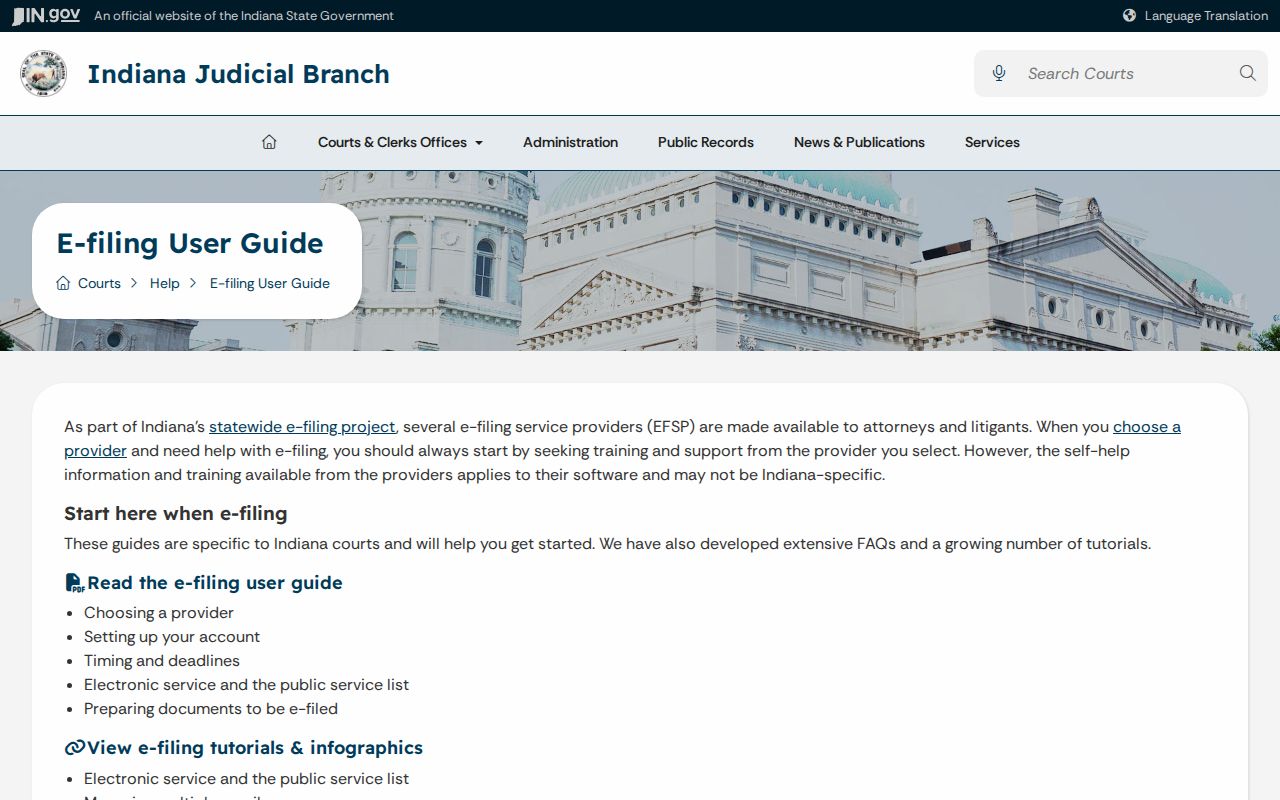
The clerk may accept or reject an electronic submission for procedural intake reasons. Once accepted, the electronic version becomes the official record. A mailed copy request, by contrast, should identify the file and document, state certification needs, include requester contact details and a return envelope, and confirm payment before money is sent.
Confidential material must be separated and filed with the required notice or form. Uploading protected data in an ordinary public PDF can expose it. The filer bears the initial duty to identify sensitive content correctly. E-filing is generally available around the clock except during maintenance, but filing deadlines and system-failure relief come from the current rules, not from the clerk's informal assurance.
The official Indiana e-filing schedule appears in the second assigned source image.
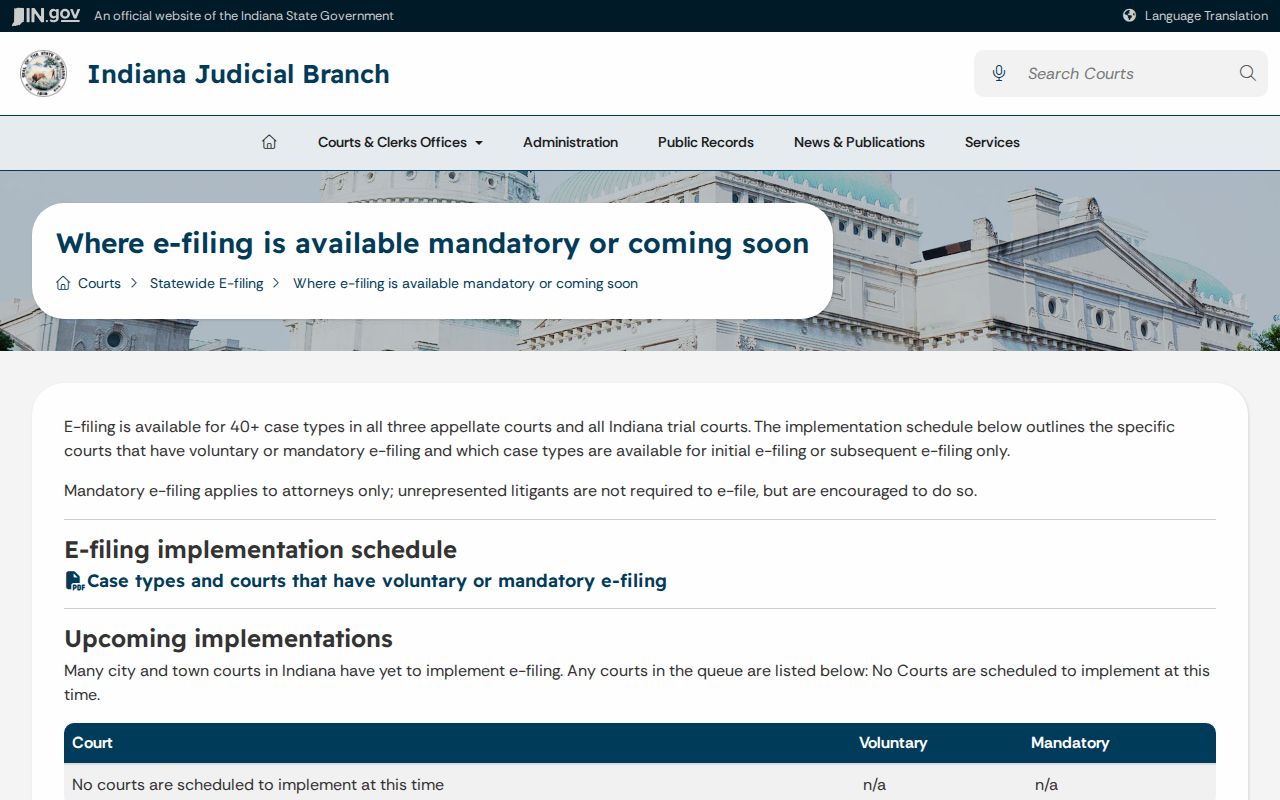
Its court and case-type status helps a filer confirm whether electronic filing is available or mandatory.
Find Any Indiana County Clerk
Use the directory of all 92 Indiana counties to reach the Clerk of the Circuit Court in the filing county. Confirm whether the office accepts requests at the counter, by mail, email, or fax, and ask for its current hours and payment methods. For older cases, ask about books, paper, microfilm, and transferred archival series. If a citation names a city or town court, contact that court's clerk instead.
The Indiana local court directory and statewide court directory provide official court and clerk contacts. Search MyCase before calling when possible. A cause number, exact document title, event date, and certification type will help the clerk give a useful answer and accurate cost.