
Search Indiana Traffic Court Records
The Indiana public ticket search and payment portal covers eligible citations in courts using Odyssey. It can locate unpaid or payable tickets, but it does not cover every parking citation, local administrative matter, or lower court. MyCase offers a second search for a filed traffic case. If neither tool returns the citation, contact the exact court printed on the ticket before its response date.
Use the citation or cause number when possible. A name and date of birth can locate some results, while a driver's-license number provides another route in the public payment system. When several tickets appear, open each result to check its own payment status. A missing online result does not extend the appearance date and should not be treated as dismissal.
- Read the citation for the court, response date, violation, and any mandatory appearance.
- Search the statewide ticket portal and MyCase by the strongest available identifier.
- If no result appears, contact the named city, town, circuit, or superior court rather than waiting past the deadline.
- Open the result and compare the citation, identity, amount, status, and court before taking action.
- Use the clerk for a certified record or for the court's current mail, counter, or appearance procedure.
Which Indiana Court Holds the Ticket
The citation identifies the court. Indiana infractions and traffic misdemeanors may be assigned to a circuit or superior court under the county caseload plan, or to an authorized city or town court. Local parking and ordinance matters may use a separate municipal administrative payment or hearing channel. Operating while intoxicated and other serious traffic crimes proceed as criminal cases, not routine payable infractions.
City and town courts are not courts of record, and their original files can remain separate from the county circuit clerk. Follow the venue printed on the citation, then use the official local directory if the matter is not in Odyssey.
- Circuit or superior court
- Infractions and criminal traffic assigned by local caseload plan; search MyCase, the ticket portal, or the county clerk.
- City or town court
- Authorized infractions, ordinance violations, and misdemeanors; use the named lower-court clerk or portal.
- Local administrative system
- Some parking or municipal matters; use the issuing municipality's official channel.
- Criminal division
- OWI, suspended driving, reckless driving, and other charged crimes; follow criminal-case procedure through the clerk.
Indiana Traffic Case Types
Classification affects the court procedure and the BMV consequence. The citation's statute and court assignment control, not a broad label such as ticket. Indiana records may concern:
- Moving infractions: speeding, signal, lane, following, and related rules.
- Equipment or registration matters: classification depends on the cited Indiana provision.
- Parking or ordinance matters: some proceed through a local administrative system rather than MyCase.
- Criminal traffic: OWI, suspended driving, leaving the scene, and serious or repeat conduct can require criminal procedure.
- Commercial driving matters: CDL reporting and masking limits make ordinary deferral assumptions unsafe.
- Camera citations: Indiana has no universal statewide camera-ticket database, so verify the issuing municipality and whether the notice is civil or ordinance-based.
A police crash report is also separate. It comes from the investigating agency or official crash-report route, not from the traffic case file or BMV driver record.
What Indiana Traffic Records Show
A public citation result summarizes the court matter. Discovery items such as calibration records, officer notes, body or dash video, and some crash evidence may remain with police or the prosecuting office rather than the public docket.
- Citation or cause number
- The ticket identifier or Indiana court case number.
- Court and county
- The venue that controls the record and response.
- Violation and statute
- The filed allegation and cited legal provision.
- Offense and appearance dates
- When the event occurred and when a response or hearing is set.
- Status and disposition
- Whether the matter is pending, paid, dismissed, defaulted, or otherwise resolved.
- Fine, costs, and amount due
- The court balance and online eligibility where displayed.
- FTA or default entry
- A failure-to-appear or default event, not necessarily a warrant.
- Paid indicator
- Whether that specific ticket result reflects payment.
Indiana Citation Search Fields
The statewide ticket portal supports more than one search route. Exact numbers reduce mistaken identity, but name and birth date help when the paper citation is unavailable. Retain leading characters and zeros as printed. Posting delay is possible, yet only the clerk can say whether waiting is safe before a deadline.
| Search Field | Type | Required | Notes / Format |
|---|---|---|---|
| Citation or case number | Text | One route | Use the exact printed identifier |
| Driver's license number | Text | One route | Follow the portal's issuing-state prompt |
| Name | Text | Alternative | Use with date of birth for identity matching |
| Date of birth | Date | With name | Distinguishes common names |
Pay or Contest an Indiana Ticket
Payment can enter an admission or judgment and waive the right to contest. Read the citation and court terms before paying. Online payment is available only when the court marks a ticket eligible. Otherwise, the named clerk provides the accepted mail or counter method. A mandatory appearance, criminal allegation, or unavailable payment button requires the court's procedure rather than an improvised payment.
- Read the citation for the court, appearance date, charge, and whether attendance is mandatory.
- Search the ticket portal and MyCase, then verify any uncertain result with the named clerk.
- Before paying, confirm the legal effect and possible BMV or insurance consequences.
- To contest, submit the required not-guilty response or appearance by the court's deadline and preserve the citation, photos, witnesses, and evidence requests.
- Ask the prosecutor or court whether diversion or deferral is available, without assuming eligibility or a statewide fee.
- Attend every hearing, obtain the final disposition and receipt, then inspect both the court file and BMV record for correct reporting.
Indiana Traffic Record Access Rules
Indiana court case access begins with the judiciary's Rules on Access to Court Records. MyCase can provide public case summaries and eligible documents, while the clerk supplies records not online and certified copies. Juvenile matters, protected identities, sealed information, and other excluded content remain restricted.
BMV data is not an anonymous court search. The federal Driver's Privacy Protection Act and Indiana privacy controls limit personal driver information and require a permissible purpose for many third-party uses. A driver may authenticate for their own record. Employers, insurers, and other requesters must use the authorized BMV route and applicable consent or purpose.
Two access tracks: Court rules govern the citation file, while federal and state privacy law govern the separate BMV driver record.
Order an Indiana BMV Driver Record
The Indiana Bureau of Motor Vehicles driver-record service offers an authenticated Viewable Driver Record, or VDR, and a certified Official Driver Record, or ODR. The VDR is free under current guidance. The certified ODR is listed at $4 and may use Request for Certified Records, State Form 53789, subject to current ordering instructions.
A BMV record may show identity and license class, current status, issue and expiration data, endorsements, restrictions, reported convictions, suspensions, failure-to-appear or failure-to-pay actions, reinstatement requirements, and CDL information as authorized. The official driver-record legend decodes entry abbreviations. It is the record to inspect for current license status, not a substitute for pleadings and evidence in the underlying court case.
After disposition, the court reports a qualifying result to BMV. Processing can create a lag between the clerk's judgment and the driver-history entry. If the court record is correct but the BMV entry is not, obtain a certified disposition and use the BMV correction or reinstatement channel. The clerk cannot promise BMV processing time or directly alter the state driver file.
Indiana Court Record Versus Driver Record
Use the court traffic record to prove what happened in one citation case. Use the BMV driver record to review the agency's compiled license and driving-history data. Correction must also follow the source.
| Record Type | Source | What It Shows | How to Access |
|---|---|---|---|
| Court traffic record | Issuing court clerk | Citation, charge, hearing, plea, deferral, judgment, fine, costs, and FTA | Ticket portal, MyCase, or clerk; correct through the court |
| Indiana driver record | Indiana BMV | License status, reported convictions and actions, restrictions, suspensions, and reinstatement data | Authenticated VDR or certified ODR; correct through BMV with proof |
Indiana CDL Traffic Records
Commercial drivers face federal and state reporting rules and employer-notice duties, including for some conduct in a personal vehicle. A disposition that might be deferred or masked for another driver can be restricted for a CDL holder. The court file records the case result, BMV applies the license consequence, and federal commercial-driver systems may receive required reporting. A CDL holder should obtain advice about those effects before accepting a proposed resolution.
Indiana OWI and Criminal Traffic
Indiana uses operating while intoxicated, or OWI, terminology. OWI, driving while suspended, reckless driving, leaving the scene, and other serious traffic allegations can proceed as criminal cases. They may require appearance, counsel, bond, and criminal discovery. They should not be handled with a routine pay-online script. The criminal court file records the charge and disposition, while BMV separately records license actions and reported convictions.
For the filing path and accusation status, review Indiana arrest and court charge records.
Indiana Deferral and Diversion
Deferral or diversion is not automatic statewide relief. Eligibility, prosecutor or court approval, fees, clean-record periods, offense limits, and CDL restrictions vary. Ask the named court or prosecutor for the current written program terms before pleading or paying. A case may remain open while conditions are completed, and failure can lead to judgment. Successful completion may avoid a conviction report, but the precise court and BMV effects depend on the approved disposition.
Indiana Traffic Record Restrictions
Qualifying criminal traffic arrests or convictions may be considered under Indiana Code 35-38-9. Ordinary infractions and BMV administrative entries follow their own rules and retention systems. Restricting a court record does not automatically rewrite every BMV transaction or federally required CDL report. The applicant should identify each source and obtain the entered court order before asking another agency to correct related data.
Indiana Traffic Record Fees
Ticket fines, costs, card charges, copy fees, and program fees vary by case and court, so use the live result or ask the clerk for a quote. The BMV product has its own price. These amounts do not include a ticket balance or local deferral charge.
| Item | Amount |
|---|---|
| Viewable Driver Record | No charge under current BMV guidance |
| Certified Official Driver Record | $4 under current BMV guidance; verify ordering terms |
| Court traffic balance | Varies by violation, court, and assessments |
| Court copy or certification | Ask the issuing clerk for the current authorized charge |
| Deferral or diversion | Program-specific fee and court costs where available |
The Indiana judiciary's unpaid ticket and tax refund intercept guidance explains the official payment check and consequences for affected balances.
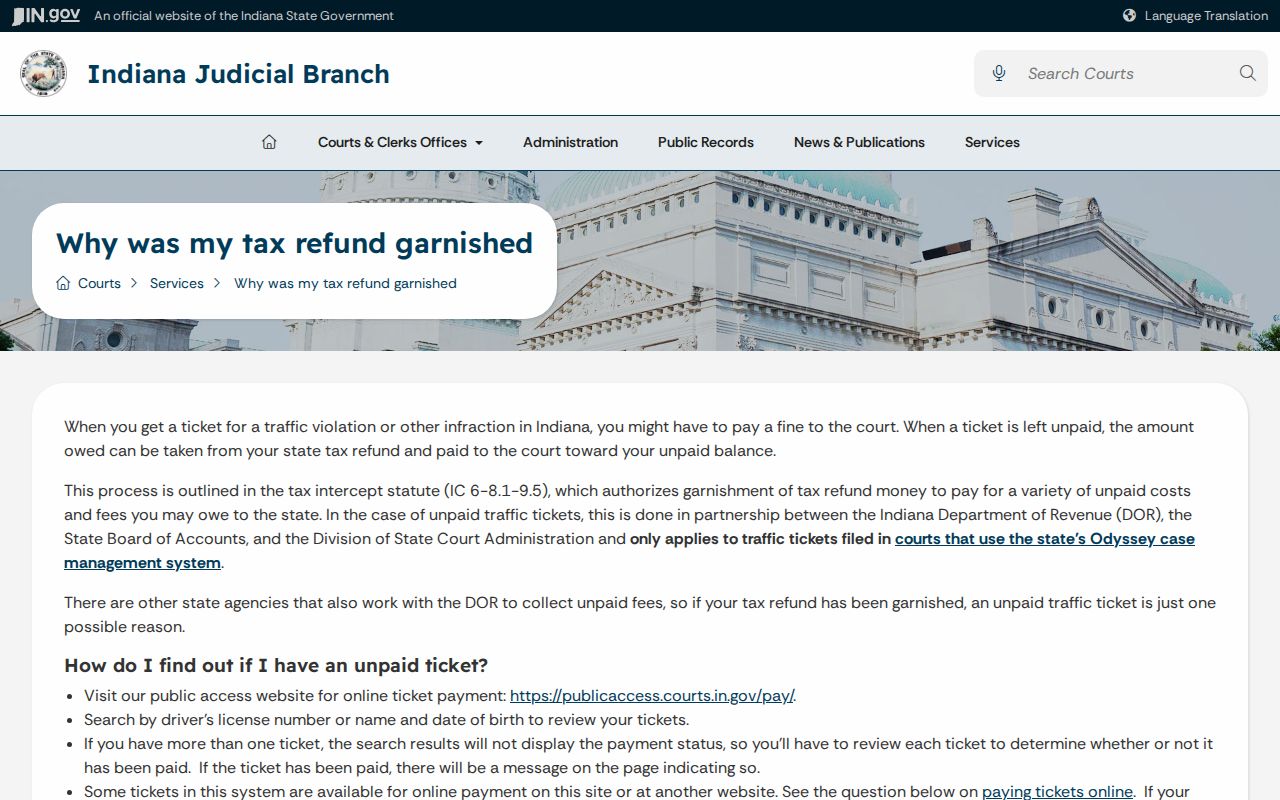
For a judiciary garnishment letter, the guidance states a 30-day payment window and a 10-percent processing fee if the Department of Revenue deduction proceeds.
Use the Indiana county directory when the ticket portal omits the case, when the citation names a local court, or when a certified case record is required.
Note: Resolving the court balance does not by itself prove that every BMV reinstatement requirement has been satisfied.