
Indiana Criminal Case Files
A county prosecutor begins the court file by filing an information, while a grand jury may return an indictment. The clerk assigns a cause number and starts the Chronological Case Summary, or CCS. From that point, the Indiana criminal court record logs the initial hearing, counsel, bond, motions, discovery notices, plea or trial, judgment, sentence, and later activity. Police reports and discovery are not automatically public court attachments, and current custody is held in a separate jail or correction system.
Indiana Circuit and Superior Courts handle felony and misdemeanor cases under local caseload plans. City and town courts may hear authorized misdemeanors, infractions, and ordinance cases. The filing court, not merely the offense level, identifies the clerk that holds the record. Indiana's unified Clerk of the Circuit Court serves county Circuit and Superior Courts, while a city or town court can remain a separate access point.
Search Indiana Criminal Court Records
MyCase searches public Odyssey case data by case identifier, party, or attorney. Criminal results can show the cause number, court, file date, defendant and counsel, each filed count, CCS events, hearings, financial entries, disposition, sentence, and selected documents. A birth date may narrow the search but is not publicly displayed. Use the Odyssey court coverage list before treating a no-result search as meaningful because older pre-migration cases may remain only in local indexes or files.
- Open MyCase and enter the cause number, or search the defendant's recorded name with a second identifying field.
- Narrow results by court, criminal case type, open or closed status, and filing period.
- Open the case and compare every count's original or amended label, statute, severity, and disposition.
- Read later CCS entries for dismissal, judgment, sentence, appeal, modification, or revocation.
- Request the filed information, judgment, or sentencing order from the filing clerk when exact proof is needed.
The original and certified documents remain with the local custodian. Use the Indiana county directory when MyCase lacks a public PDF or the case predates a court's Odyssey migration.
Indiana Criminal Case Stages
An arrest does not itself create a filed criminal court case. The prosecutor reviews law-enforcement material and may decline, ask for more work, file an information, or seek an indictment. Once filed, each stage produces a different type of record. Discovery may be exchanged between parties without becoming a public download, while motions and court orders usually create CCS entries.
Case flow: Charges Filed › Arraignment › Pretrial / Motions › Plea or Trial › Disposition › Sentencing
- Charges filed
- An information or indictment states alleged counts; the clerk assigns the cause and opens the CCS.
- Initial hearing
- The judge states allegations and rights, addresses counsel and bond, and sets dates.
- Pretrial and motions
- Parties exchange discovery and litigate suppression, dismissal, continuance, bond, or other requests.
- Plea or trial
- A plea agreement awaits court action, or a judge or jury returns a count-specific verdict.
- Disposition and sentencing
- Each count receives an outcome, and the order may set time, credit, probation, restitution, fines, costs, and conditions.
Later events matter. A notice of appeal, sentence modification, probation revocation, post-conviction case, or expungement can alter access or legal effect after the first judgment.
What Indiana Criminal Records Show
MyCase organizes case-level data and count-level data in one view. Do not collapse them. A closed case can contain one conviction, one dismissal, and one amended count. A filing classification such as F6 identifies the case type when opened; it does not prove a Level 6 felony conviction.
| Field | What It Shows |
|---|---|
| Cause number and court | Filing county, court identifier, filing period, case type, and sequence. |
| Defendant and counsel | Party identity, prosecutor, defense lawyer or public defender, and assigned judicial officer. |
| Charges | Count number, offense label, Indiana Code citation, severity, date, amendment, and status. |
| CCS | Dated filing, warrant, hearing, bond, motion, order, plea, trial, judgment, sentence, and appeal events. |
| Plea and disposition | The response and final result for each count, which must be read separately. |
| Sentence | Executed or suspended term, concurrency, credit, probation, restitution, fine, costs, and conditions when entered. |
| Documents | Selected public charging papers, motions, orders, judgments, or notices; confidential material is excluded. |
Current custody belongs to the jail or Indiana Department of Correction, not the old sentencing line. A sentence also may be changed later. For a legal conclusion, obtain the entered judgment and sentencing order rather than relying only on the case header.
Indiana Charges Versus Convictions
A filed charge is a formal allegation. It may be amended, reduced, dismissed, or tried. A conviction requires an entered guilty plea or guilty verdict followed by judgment. Indiana criminal court records preserve the path, so the original charging label must not be reported as the final result. The more detailed Indiana arrest and court charge record explanation tracks the booking-to-filing distinction.
| Charge | Conviction | |
|---|---|---|
| Meaning | Prosecutor or grand jury formally alleges an offense | Court enters guilt after plea or verdict |
| Best source | Information or indictment and current count table | Judgment and sentencing order |
| Possible change | Amended, reduced, added, or dismissed | May face appeal, modification, or expungement |
| Reporting rule | Always call it an allegation | Report the exact count and current legal status |
Probable cause can support an arrest or initial judicial action, while proof beyond a reasonable doubt governs a contested criminal conviction. Neither standard permits a public reader to skip the entered result.
Read Indiana Criminal Dispositions
Pending or filed means the allegation awaits a final result. Dismissed means the count ended without conviction, although whether dismissal bars refiling can matter. Acquitted or not guilty means the factfinder did not convict. Guilty plea or guilty finding supports conviction once judgment is entered. Diversion or deferral has the effect stated in the program agreement and court order; local eligibility and dismissal terms cannot be assumed statewide.
A sentencing order can divide time into executed and suspended terms and state whether counts run at the same time or one after another. It may also address credit time, probation, restitution, fines, costs, and special conditions. Read later CCS entries for modification or revocation. A MyCase balance may not be the clerk's current payoff, and an Indiana Department of Correction profile is the better source for current state-prison status.
Indiana Sealed Versus Expunged Records
Indiana Code 35-38-9 provides different routes for eligible arrests, charges without conviction, misdemeanors, Level 6 felonies, and more serious convictions. Waiting periods, conditions, excluded offenses, prosecutor consent, and filing rules vary. Petitioners must identify the right county and consolidate matters as the statute requires. A judge, not clerk counter staff, decides relief.
| Sealed | Expunged | |
|---|---|---|
| Public visibility | Restricted by rule, statute, or order | Restricted according to the granted IC 35-38-9 order |
| Destruction | Not necessarily destroyed | Not physical destruction of every copy |
| Justice access | Authorized access can remain | Specified criminal-justice access and use can remain |
| Proof | Sealing order and current docket | Certified expungement order and updated repository results |
After an order, the clerk transmits it to affected repositories. Verify both MyCase and Indiana State Police output after processing. A private copy made before restriction may require a separate dispute.
Access Indiana Criminal Court Records
The Indiana Rules on Access to Court Records govern judicial case-file access. The Access to Public Records Act applies to agency records, such as police or sheriff material, but recognizes the Supreme Court's control of court records. Indiana Administrative Rule 9 addresses administration and bulk data. MyCase provides free anonymous access to eligible data and documents. The filing clerk supplies public documents that are not online and certifies copies for formal use.
Key Statutes:
Indiana Code 10-13-3 defines and limits criminal-history collection and dissemination.
Indiana Code 31-39 controls access to juvenile court and law-enforcement records.
A public docket entry may remain visible while its supporting attachment is excluded. Ask the clerk whether a missing item is unavailable online, redacted, or legally restricted.
Indiana Statewide Criminal History
The Indiana State Police Limited Criminal History is a person-based repository product, not a single court case. It contains reported Indiana felony and misdemeanor arrests and dispositions, subject to county participation and reporting quality. It is Indiana-only and name-based. Result categories are On File, Inconclusive Results, and No Records Found. None should be stretched beyond the product's scope.
The online or mail search uses legal name, birth date, race, gender, and other identifiers when needed. Current pricing should be verified in the live service or form. The ISP Criminal History Services page also directs users to fingerprint-based National Full Criminal History when the more complete authorized product is required.
The official ISP history services are represented in the assigned image below.
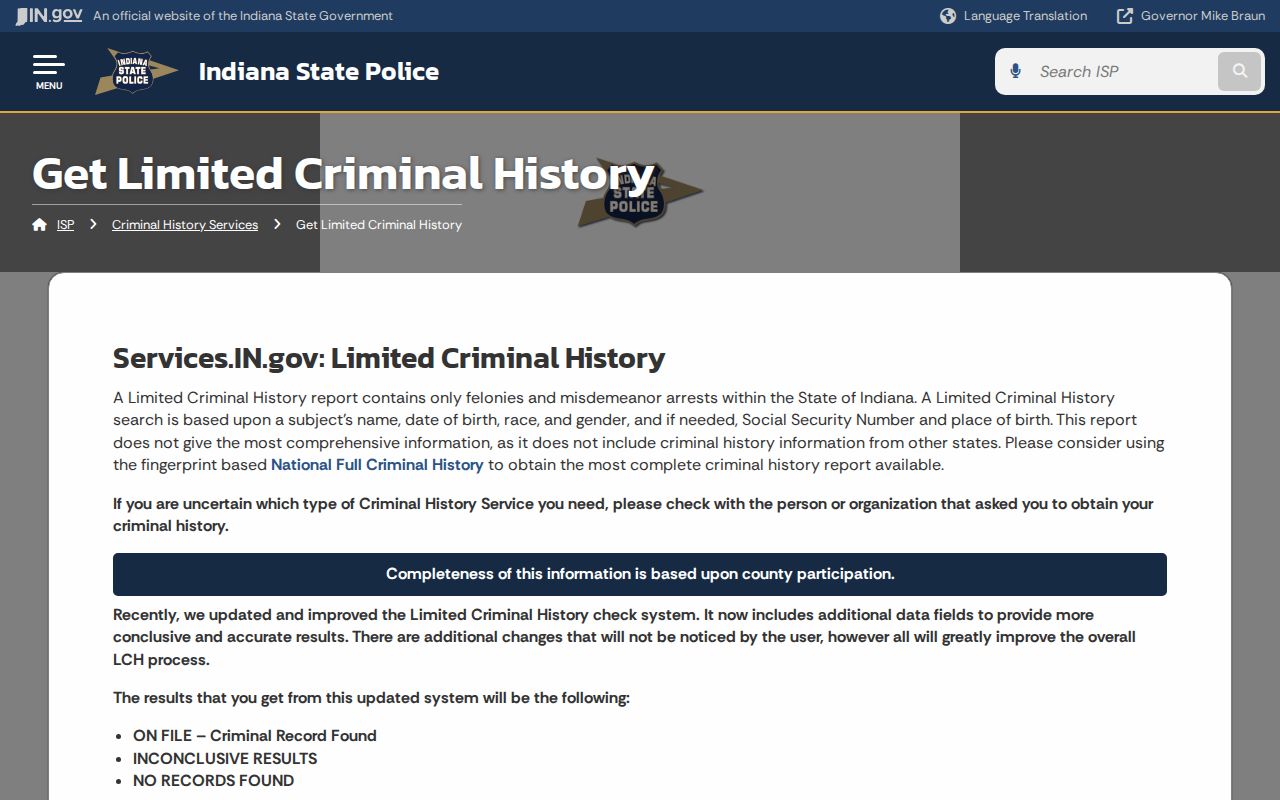
Its person-based result must be reconciled with the certified judgment from the county court when a disposition is missing or unclear.
The broader criminal-history services overview is also documented by this second assigned image.
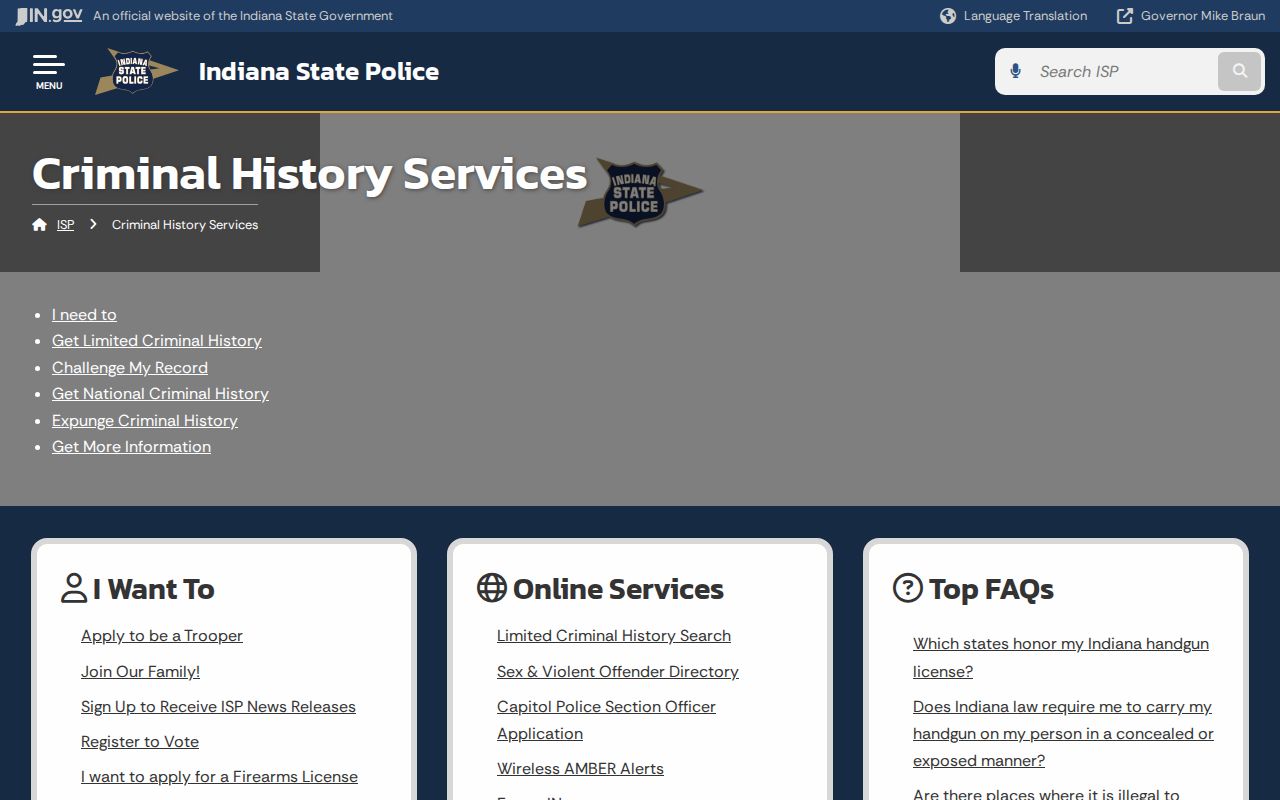
Together, the two sources show why the requested use should determine whether a name check or authorized fingerprint product is appropriate.
Important: Employment, housing, credit, licensing, and other decisions may require consent, an authorized product, accuracy safeguards, and adverse-action procedures.
Restricted Indiana Criminal Records
Juvenile records have category-specific limits under Indiana law. Grand-jury materials, confidential informant data, protected victim or witness addresses, full birth dates, Social Security numbers, account numbers, medical material, and sealed warrant papers can be excluded or redacted. Active investigative files held by police are distinct from the filed court record and may be withheld under agency-record rules. Expunged or sealed cases may disappear from anonymous MyCase and ordinary background dissemination even though lawful justice access remains.
For a wrong court entry, preserve the cause number and contact the filing clerk. For an ISP history with a missing disposition, obtain the certified judgment or dismissal and follow the ISP challenge route. Each custodian corrects its own system. A same-name hit is not enough to identify a person, and sensitive identifiers should be submitted only through an authorized secure channel.