
Search Indiana Court Records
Indiana MyCase is the first stop for a free public search of cases stored in the Odyssey case-management system. It accepts a case, citation, or cross-reference number, as well as a party, business, or attorney search. Results can show the court, cause number, filing date, case type, parties, attorneys, charges or issues, hearings, financial entries, the chronological case summary, and selected public documents. Anonymous document access is narrower than access for a verified party or attorney. MyCase also caps a query at 1,000 results, so broad names need a county, court, date, status, or case-type filter.
Coverage began at different times because Indiana courts moved to Odyssey county by county. A blank result does not prove that no case exists. Pre-migration files, paper exhibits, documents withheld from anonymous access, and records from some city or town courts may require the local clerk. The official Odyssey coverage list gives each court's start date. Indiana's MyCase search tips also explain wildcards, name variations, and cause-number searches.
| MyCase control | Input | Use |
|---|---|---|
| Search by Case | Case, citation, or cross-reference number | Best route when an identifier is known |
| Search by Party | Last name plus first, middle, or date of birth | Narrows people; date of birth is not displayed publicly |
| Business Name | Recorded business name | A trailing wildcard can account for suffix differences |
| Search by Attorney | Roll number or attorney name | Locates cases tied to recorded counsel |
| Filters | Court, case type, status, and file-date range | Reduces broad results and the 1,000-result cap |
- Start in MyCase and choose the case, party, business, or attorney tab that matches the information available.
- Use the full cause number when known. For a name search, add a first name, middle name, date of birth, court, or filing range.
- Open the matching result and read the newest chronological case summary entries before relying on status, balance, or hearing data.
- If the file is absent or a document link is missing, confirm the court's Odyssey start date and identify the filing county.
- Contact that county's Clerk of the Circuit Court for legacy material, a current financial statement, or a plain, certified, or authenticated copy.
The Indiana Judicial Branch homepage connects case search with court rules, forms, local courts, and statewide services.  It helps separate an official court channel from unrelated commercial search pages.
Indiana Court Records Structure
The Indiana court system has one Supreme Court, a 15-judge Court of Appeals organized into five selection districts, and a one-judge Tax Court for original state tax appeals. County-level Circuit Courts are constitutional courts of general jurisdiction. Statutory Superior Courts share broad trial work in most counties. Local caseload plans, not the label alone, decide which judge receives a felony, civil, domestic-relations, juvenile, probate, guardianship, or small-claims case.
City and town courts handle authorized ordinance, infraction, traffic, and misdemeanor matters. They are not courts of record. An appeal therefore proceeds as a new trial in a Circuit or Superior Court. Marion County also has nine township-based Small Claims Court divisions. Probate is generally a division or docket of a Circuit or Superior Court, although Marion and St. Joseph have separately named probate courts. One elected Clerk of the Circuit Court maintains the county's Circuit, Superior, and probate records.
Typical appeal path: City or Town Court › Circuit or Superior Court › Court of Appeals of Indiana › Indiana Supreme Court
| Court | Jurisdiction | Case Types |
|---|---|---|
| Indiana Supreme Court | Final state appellate authority and judicial administration | Transfer petitions, direct death or life-without-parole appeals, discipline, constitutional rulings |
| Court of Appeals of Indiana | Most civil and criminal appeals as of right | Trial judgments, convictions, family cases, post-conviction and assigned agency review |
| Indiana Tax Court | Statewide original tax appeals | State revenue and property-assessment determinations |
| Circuit, Superior, and Probate Courts | General trial jurisdiction under local caseload plans | Criminal, civil, family, juvenile, probate, guardianship, and small claims |
| City and Town Courts | Limited local jurisdiction | Ordinances, infractions, traffic, and authorized misdemeanors |
Indiana Court Record Types
Indiana court records reflect the docket on which a case was filed. Civil files can include complaints, service returns, answers, motions, judgments, liens, evictions, and proceedings supplemental. Criminal files follow charges from an information or indictment through hearings, pleas, motions, verdict, disposition, sentence, probation, and later petitions. Domestic-relations records include divorce, custody, support, paternity, adoption, and protective-order matters, but access can narrow when children, protected addresses, or confidential reports are involved.
- Criminal records: Filed charges, CCS events, pleas, rulings, disposition, sentence, and post-conviction activity.
- Civil records: Claims, service, responses, evidence filings, orders, judgments, and collection activity.
- Family records: Divorce, custody, support, paternity, adoption, and protection cases with access limits where required.
- Probate records: Estates, wills, personal representatives, claims, inventories, guardianships, and court orders.
- Traffic records: Citations and court dispositions, distinct from the driver history maintained by the BMV.
- Appellate records: Notices, briefs, motions, orders, opinions, and transfer proceedings based on the trial record.
The Indiana public court records hub explains the official access routes.  Its organization reinforces that summaries, documents, bulk data, and administrative records may use different request channels.
What Indiana Court Records Show
A public MyCase result normally begins with the cause number, caption, court, case type, file date, and open or closed status. The detail view may add parties and roles, attorneys, judicial officers, charges or claims, hearings, financial assessments, public documents, and the chronological case summary. The CCS is the event log. It records filings, settings, service, orders, continuances, pleas, judgments, and other court action in date order. A closed label only describes case administration. It does not say who won, whether every count ended the same way, or whether money remains due.
- Cause number
- Encodes county, court, filing year and month, case type, and sequence for a modern trial case.
- Filing date and status
- Shows when the action opened and whether the clerk treats it as open or closed.
- Parties and attorneys
- Identifies litigants, defendants, petitioners, counsel, and their roles in that case.
- Charges or issues
- Lists criminal counts or the civil, family, probate, or appellate matter before the court.
- CCS events
- Provides the dated log of filings, hearings, orders, service, pleas, and rulings.
- Disposition and judgment
- Records how claims or counts ended and any sentence, award, dismissal, or final order.
Indiana Statewide Record Systems
MyCase is only one part of Indiana public records access. The Indiana Department of Correction locator covers people committed to state custody, not everyone booked in a county jail. Indiana State Police offers a paid Limited Criminal History product based on name and date of birth, while a court case file remains with the filing clerk. The Bureau of Motor Vehicles maintains driver status and conviction history separate from a traffic court's citation file. The Indiana Department of Health can search qualifying marriage records but does not issue a divorce decree.
These distinctions matter when names cross systems. A county booking can exist before a court filing. A court conviction may take time to reach a driver record or criminal-history repository. An IDOC profile can remain separate from the county CCS that produced the sentence. Indiana VINE/SAVIN adds custody and case notifications, while the Sex and Violent Offender Registry serves a different public-safety purpose. Each source has its own update process and correction path.
| System | What It Holds | Run By |
|---|---|---|
| IDOC Incarcerated Locator | People in state correctional custody and profile data | Indiana Department of Correction |
| Limited Criminal History | Indiana felony and misdemeanor arrest history within repository limits | Indiana State Police |
| Driver Record service | License status and state driving history | Indiana Bureau of Motor Vehicles |
| Vital Records | State vital records and qualifying marriage searches, not divorce decrees | Indiana Department of Health |
Indiana Court Records Access Law
Indiana begins with public access, but judicial case records use court-specific rules. The Rules on Access to Court Records define what the public may inspect and what must be excluded or redacted. Administrative Rule 9 addresses court-record administration and bulk dissemination. Indiana's Access to Public Records Act is the main route for executive and local agency records, including many sheriff, jail, BMV, and State Police administrative records. APRA itself recognizes the Supreme Court's authority over judicial records, so an APRA request sent to the wrong office does not replace a case-record request to the clerk.
Key Statutes:
Indiana Code 5-14-3 establishes APRA inspection and copy rights for public-agency records and identifies exceptions.
Rules on Access to Court Records 4 and 5 establish public access while excluding protected records and information.
Indiana Code 35-38-9 governs restriction of qualifying arrest, charge, and conviction records through expungement.
Indiana Code 31-39 controls access to juvenile court and law-enforcement records.
The Indiana courts' self-service center collects forms and procedural material for people handling matters without counsel. Its official resource page is the source for the image below.  Forms do not guarantee access or a particular ruling, but they help users follow the court's accepted process.
Restricted Indiana Court Records
Public access does not expose every filing or field. Juvenile delinquency, CHINS, paternity, termination, and law-enforcement records have category-specific limits. Adoption material and identifying information are confidential. Mental-health commitment files and clinical evidence are restricted. Courts also exclude full Social Security and account numbers, full dates of birth, protected addresses, medical records, and designated information about minors or victims. Grand-jury matters, confidential-source material, sealed warrant papers, and active-investigation records can also remain unavailable.
An expungement under Indiana Code 35-38-9 can restrict qualifying arrest, charge, and conviction records after the required conditions and waiting period. Relief depends on the record category, offense, later history, and filing details. The petition belongs in the court and county tied to the matter. Once an order issues, the clerk transmits it to relevant repositories, but lawful criminal-justice access can remain. Expungement is not the physical destruction of every copy.
The 2026 court-record rule changes include added safeguards for handling exhibits. The 2026 State of the Judiciary also describes statewide modernization.  New technology expands connections without making every sensitive record public.
Find Indiana Records by County
Every Indiana county has an elected Clerk of the Circuit Court who maintains local Circuit, Superior, and probate case records. The largest court systems add divisions and specialized dockets, yet the same routing rule applies: identify the filing county, search MyCase, and ask that county's clerk for documents that are not public online. The six populous counties below illustrate Indiana's metro and regional systems.
Marion County
Indianapolis · Indiana's largest system, with separate probate and township small-claims courts
Lake County
Crown Point · Large northwest Indiana Superior Court system with multiple divisions
Allen County
Fort Wayne · Circuit Court and specialized Superior Court divisions
Hamilton County
Noblesville · Fast-growing suburban dockets using MyCase and a unified clerk
St. Joseph County
South Bend · One of two Indiana counties with a separately named Probate Court
Vanderburgh County
Evansville · Regional court center with Circuit Court and several Superior divisions
Browse the full directory of all 92 Indiana counties to open the court records site for any county.
The Judicial Branch maintains an official local courts and clerks directory. 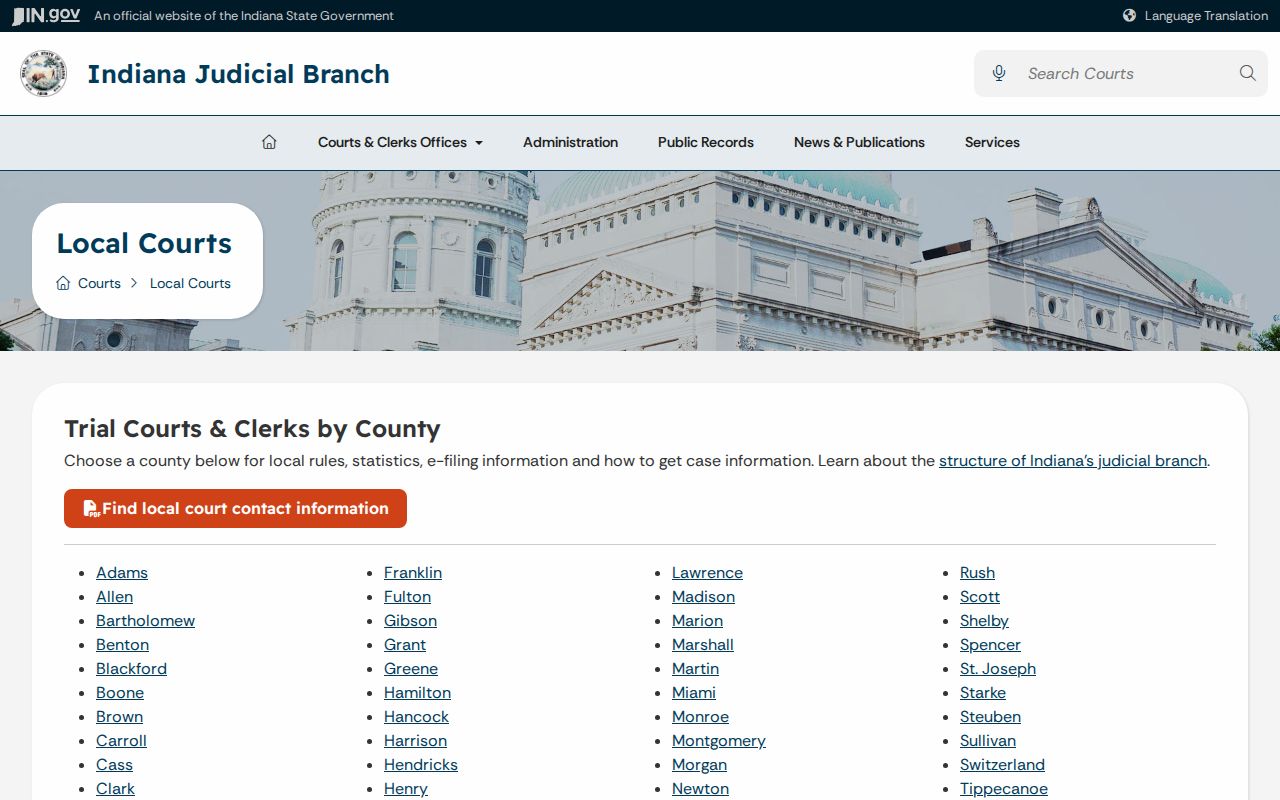 It is useful for confirming current court and clerk contacts before a visit or mailed request.
Indiana Court Records Fees
A MyCase search is free, but a clerk may charge for paper, certification, authentication, postage, or a filing. Trial-court filing totals combine state, county, local, storage, service, and program components. The Trial Court Fee Manual lists base components, including $100 for a civil filing, $35 for small claims outside Marion township courts, and $120 for probate or trust filing. Those are not final statewide quotes. Party count, sheriff service, publication, local assessments, and case type can change the total.
- MyCase public search
- Free.
- Civil filing base component
- $100 before applicable additions.
- Small claims base component
- $35 outside Marion township courts.
- Probate or trust filing base component
- $120 before applicable additions.
- Appellate filing
- $250, subject to exemptions and current rules.
- Appellate clerk copy and certification
- $1 per page plus $1 per document certification.
Read Indiana Court Records
A cause number is a compact map. In 53C02-1512-F6-001234, the first two digits identify Monroe County, the letter and following digits identify the court, the next four digits give filing year and month, F6 marks the case type, and the final digits are the sequence. The code identifies venue and category, not guilt. MyCase permits searches without hyphens and supports wildcards in the formats described by its tips.
Read charges count by count and pair each with its final disposition. One count may be amended, another dismissed, and another end in conviction. A proposed order is not an entered order. A plea agreement is not the judgment. A service return proves the recorded service event, not the truth of a complaint. Financial entries can also lag payments, interest, refunds, bond action, or collections. Ask the clerk for an official current balance when payment or release depends on it.
The Odyssey coverage page documents when individual courts joined the statewide platform. That official coverage source supports the image below. 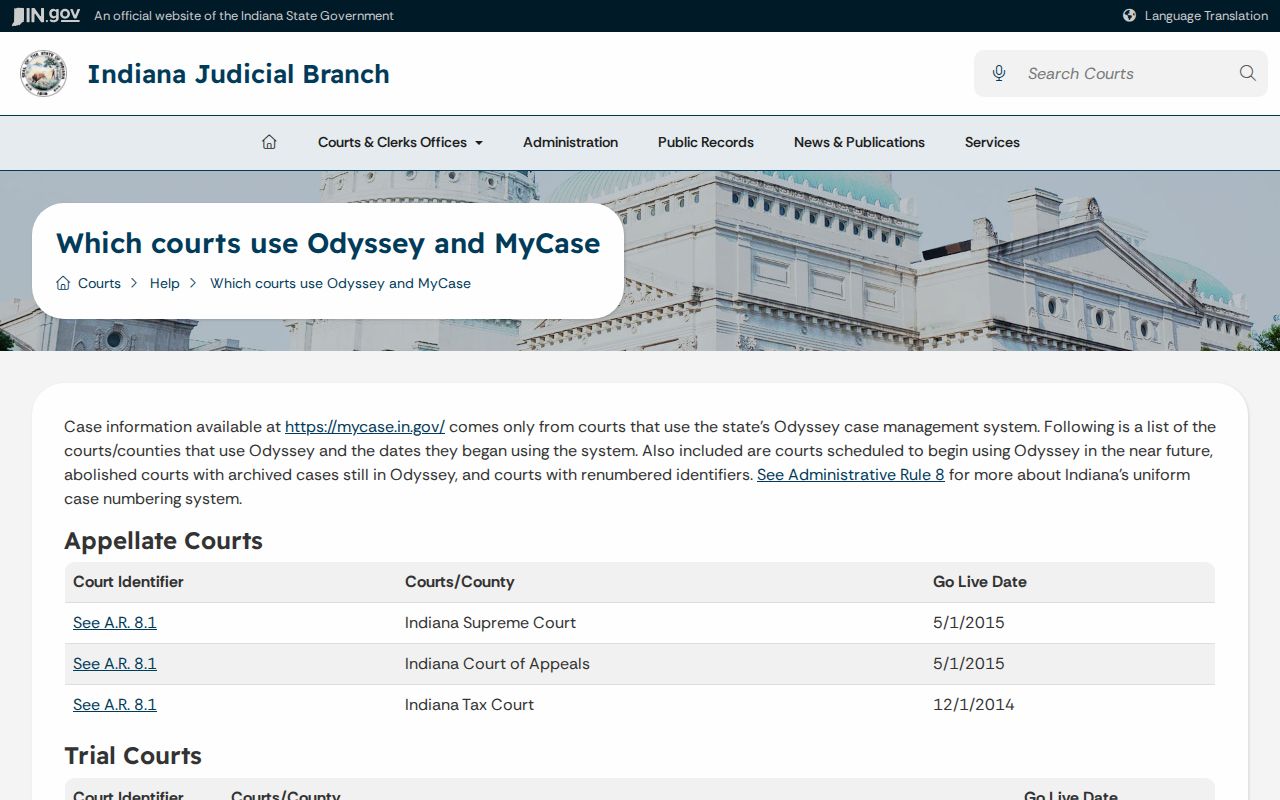 It explains why older local files may not appear in the same search.
Indiana Record Accuracy Limits
Online records reflect data entered by courts and agencies at different stages. A hearing can be reset by a later order. The listed attorney may show representation at that time, not current responsibility. A judge field can show assignment rather than the officer who signed each ruling. Document metadata should be checked for title, filing date, filer, event number, and a court stamp. When a MyCase entry conflicts with a signed order, the local clerk and court record control.
Corrections follow the source. The clerk addresses court-data issues through court procedure, Indiana State Police handles criminal-history challenges, BMV handles driver records, the sheriff handles booking and registry data, and IDOC handles prison profiles and sentence calculations. Sending one correction request to every system will not synchronize them. Start with the record that is wrong and provide the identifiers and supporting official document that its custodian requests.
Note: Confirm a hearing, balance, disposition, or certified-document need with the Indiana county clerk that holds the original case file.
Indiana Court Records Questions
Is MyCase an official Indiana court record?
MyCase is the Indiana judiciary's official public search for Odyssey case data, but its online summary is not a certified copy. Use the filing county's Clerk of the Circuit Court when an agency, employer, another court, or licensing body requires a sealed or certified document.
Why does an older Indiana case not appear?
Courts adopted Odyssey on different dates. A file from before a court's migration may remain in paper, microfilm, an older index, or a local image system. Check the official coverage date, then ask the clerk in the filing county to search legacy holdings.
Are all Indiana court documents public online?
No. A public docket can exist while individual documents are unavailable anonymously, restricted to verified parties, excluded by access rules, sealed, or never scanned. The clerk can explain whether a public copy is available, but cannot disclose a protected record without legal authority.
Does a closed case mean a conviction?
No. Closed is an administrative status. A criminal case may close after dismissal, acquittal, plea, trial conviction, or another resolution. Civil cases can close after settlement, dismissal, default, or judgment. Read the disposition for each claim or count.
Where are Indiana county court documents kept?
The elected Clerk of the Circuit Court in the filing county maintains Circuit, Superior, and probate files. A city or town court can have its own clerk. The appellate clerk handles Supreme Court, Court of Appeals, and Tax Court records, not local case copies.