
Indiana Court Hierarchy at a Glance
The Indiana Supreme Court is the court of last resort for civil and criminal matters. Indiana has no separate criminal high court. Most appeals from courts of record go to the Court of Appeals of Indiana, whose 15 judges are associated with five districts but sit in rotating three-judge panels with statewide authority. The Indiana Tax Court hears original appeals from specified state tax agencies. Circuit and superior courts do most trial work. Probate is normally a docket within those courts, except for separately named probate courts in Marion and St. Joseph.
City and town courts hear authorized ordinance, infraction, traffic, and misdemeanor cases. They are not courts of record. Their appeals proceed to a circuit or superior court for a new trial. Marion County also has nine township-based small-claims divisions, with a new trial available in Marion Superior Court. Elsewhere, small claims are dockets within circuit or superior courts.
Typical appeals path: Circuit or Superior Court › Court of Appeals of Indiana › petition to transfer to the Indiana Supreme Court
| Court Level | Court Name | Jurisdiction / Case Types | Number in Indiana |
|---|---|---|---|
| Last resort | Indiana Supreme Court | Specified direct appeals, discretionary transfer, discipline, rules, and supervision | 1 court, 5 justices |
| Intermediate appellate | Court of Appeals of Indiana | Most civil and criminal appeals as of right and assigned agency review | 1 court, 15 judges in 5 districts |
| Specialized statewide | Indiana Tax Court | Original appeals from designated state tax agencies | 1 court, 1 judge |
| General trial | Circuit and superior courts | Criminal, civil, family, juvenile, probate, guardianship, and small claims under local plans | Circuit court serves all 92 counties; superior courts vary |
| Limited local | City and town courts | Ordinance, infraction, traffic, and authorized misdemeanor matters | Locally created; count varies |
| Special local | Marion County Small Claims Court | Small claims and possession matters by township | 9 divisions |
The assigned Court of Appeals source gives an official view of Indiana appellate jurisdiction.
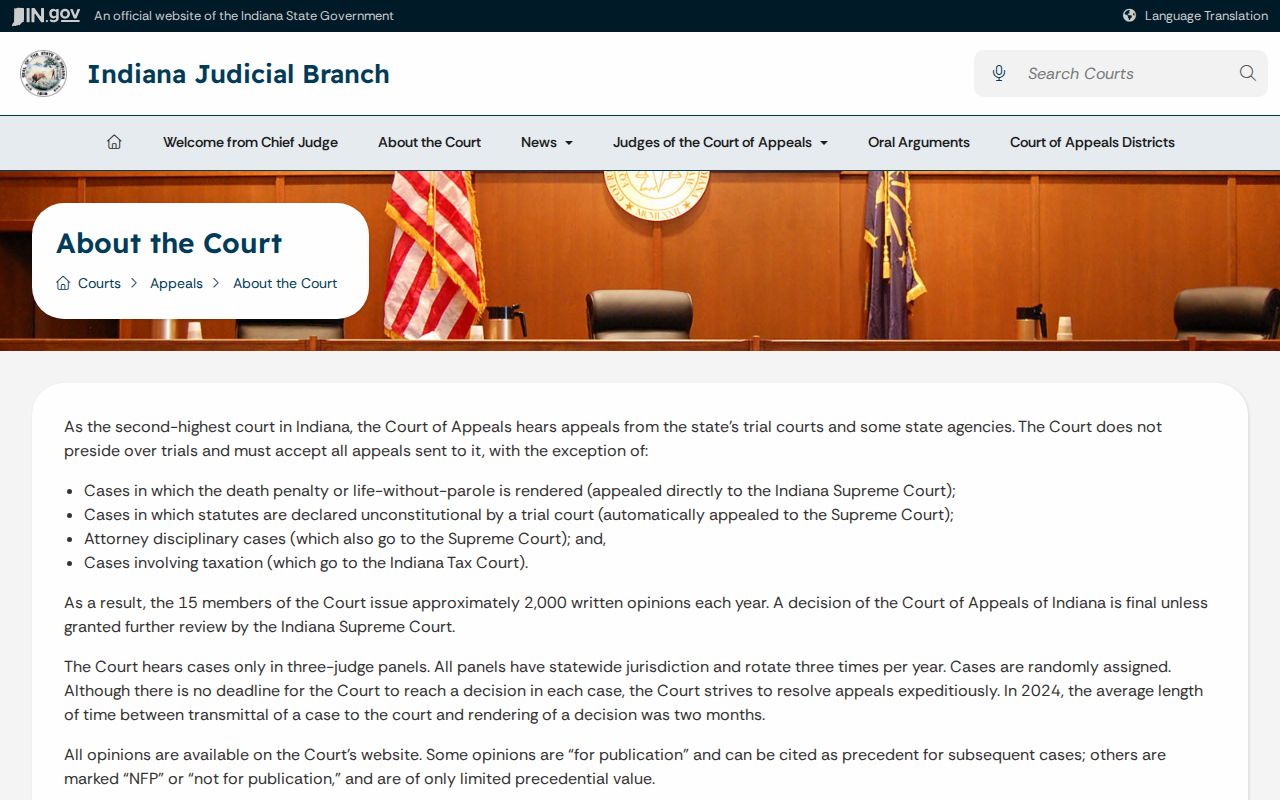
That source also helps explain why district selection and statewide panel authority should not be confused.
Indiana Supreme Court
The Indiana Supreme Court has five justices and final state-law authority. It directly reviews death and life-without-parole cases, trial rulings that declare a statute unconstitutional, attorney and judicial discipline, and specified mandate matters. For most ordinary appeals, it decides whether to accept transfer after the Court of Appeals rules. It also adopts procedural and access rules and supervises the judicial branch.
Indiana uses merit selection through the Judicial Nominating Commission and retention elections for appellate judges. The Supreme Court has no separate criminal counterpart, so its authority spans both civil and criminal law. Its binding opinions guide every lower Indiana court. The court's physical home in the Statehouse also links the modern judiciary to Indiana's nineteenth-century civic center.
The assigned Indiana Supreme Court source shows the official jurisdiction and services.
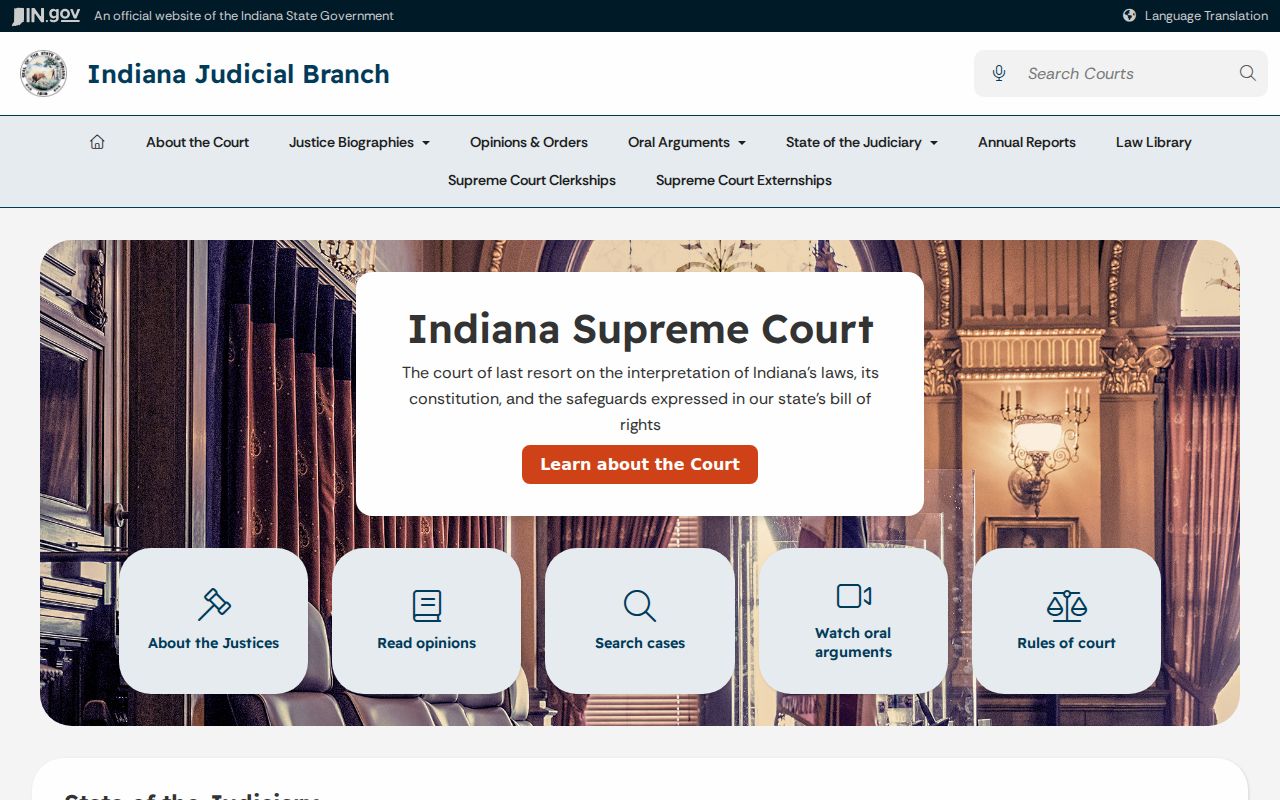
Use that official court source for opinions, oral arguments, rules, reports, and current court information.
Indiana Court of Appeals
The Court of Appeals of Indiana must hear most properly perfected civil and criminal appeals and certain agency reviews. It conducts no trials. Fifteen judges are selected from five geographic districts, with three judges associated with each district. That district geography is chiefly a selection device. Rotating three-judge panels decide cases statewide, so a panel's authority is not limited to the counties in a judge's home district.
| District | Seat | Counties Served |
|---|---|---|
| Districts 1 through 5 | Geographic selection districts | Three judges associated with each district |
| Deciding panel | Rotating statewide panel | Three judges hear each appeal |
| Further review | Indiana Supreme Court | Petition to transfer, usually discretionary |
Indiana Circuit and Superior Courts
Circuit courts are Indiana's constitutional base trial courts. Every county belongs to a judicial circuit. Superior courts are created by statute and generally share broad trial jurisdiction rather than sitting beneath circuit courts. Local caseload allocation plans determine which judge hears felonies, civil disputes, domestic relations, juvenile matters, probate, guardianship, protective orders, or small claims. The label alone does not reliably identify the subject docket.
One elected Clerk of the Circuit Court receives filings for the county's circuit, superior, and probate courts and assigns uniform cause numbers under local rules. Trial judges are state judicial officers operating through county courthouses, while local staff, funding, schedules, and legacy storage differ. Search MyCase first, then contact the filing county for older or unposted material.
Indiana Court Jurisdiction Compared
Jurisdiction turns on both the court tier and a county's caseload plan. Indiana has no statewide district-court layer between general trial and local limited courts.
| Circuit or Superior | City or Town | Marion Small Claims | |
|---|---|---|---|
| Core work | General civil, criminal, family, juvenile, probate, and small claims | Ordinance, infraction, traffic, and authorized misdemeanor | Small claims and possession matters |
| Court of record | Yes | No | Special statutory organization |
| Local allocation | County caseload plan | Creating law and local assignment | Township division |
| Review route | Court of Appeals, with direct exceptions | New trial in circuit or superior court | New trial in Marion Superior Court |
How Indiana Appeals Move
A civil complaint or criminal information begins in the court assigned under the local plan. The clerk creates the cause number and docket. After judgment, a timely Notice of Appeal starts record assembly. The Court of Appeals reviews the record for legal error and does not retry witnesses. A party may seek rehearing and then ask the Supreme Court to accept transfer. Death, life-without-parole, and specified constitutional cases bypass the ordinary first appellate step.
Criminal flow: Charge › initial hearing › pretrial motions › plea or trial › disposition › sentence › Court of Appeals › petition to transfer
Civil flow: Complaint › answer › discovery › mediation or motions › trial or judgment › Court of Appeals › petition to transfer
Non-record local flow: City or town court judgment › new trial in circuit or superior court
Indiana Tax and Specialty Courts
The Indiana Tax Court is a statewide court with one judge and exclusive original jurisdiction over appeals from the Department of State Revenue, Department of Local Government Finance, and Indiana Board of Tax Review. Its appeals go to the Indiana Supreme Court. It is distinct from a federal tax case and from a county property dispute that has not completed the required agency path.
The assigned Indiana Tax Court source documents this specialized place in the court system.
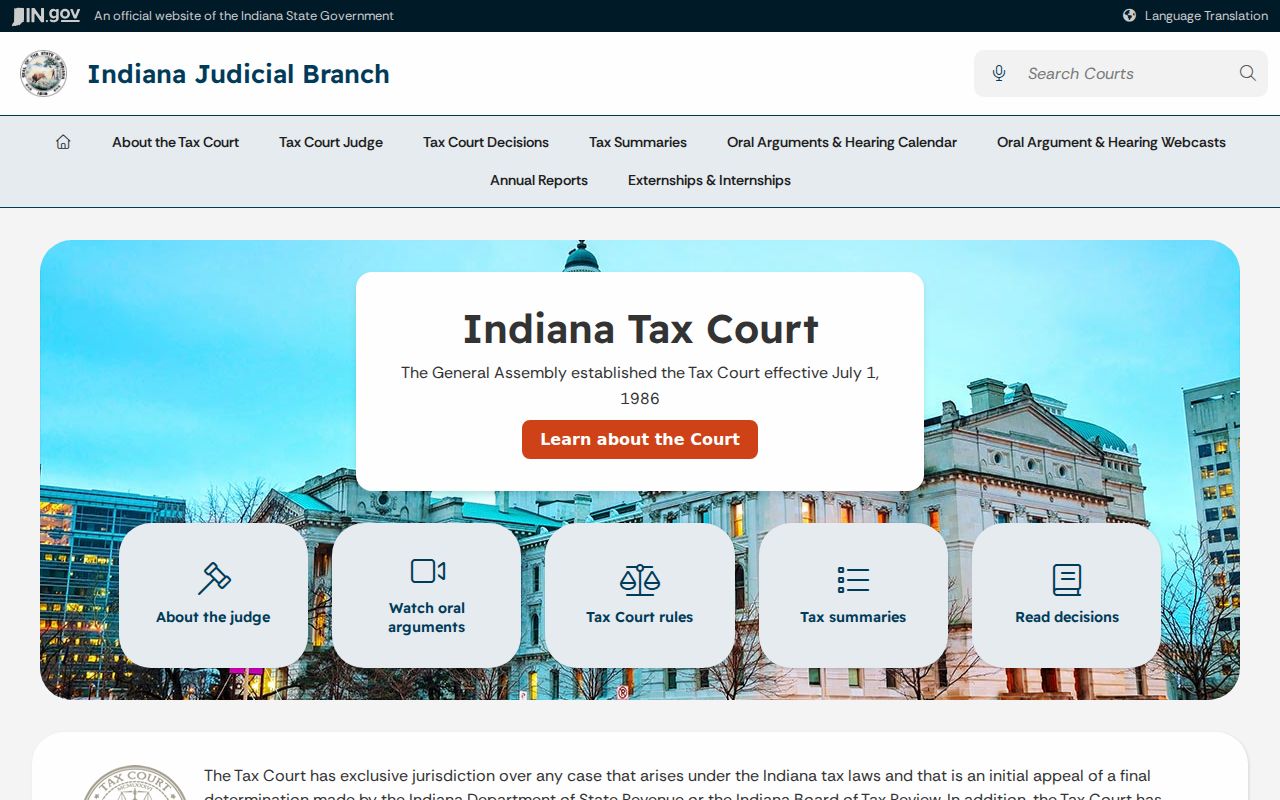
Indiana also certifies problem-solving dockets for drug treatment, veterans, mental health, reentry, family recovery, and impaired-driving cases. Commercial Courts are designated dockets for qualifying business disputes. Neither creates another appellate tier.
Indiana City and Town Courts
City and town courts are locally created courts of limited jurisdiction. They commonly hear ordinance violations, infractions, traffic matters, and misdemeanors authorized by law. They are not courts of record, which means an appeal does not ask a higher court to review a full trial transcript in the usual way. The circuit or superior court hears the matter anew.
These local courts can have their own clerks and files. A county Clerk of the Circuit Court may not hold the original city or town docket. Read the issuing citation or case caption before requesting a record. Magistrates, by contrast, can serve within a trial court and are not a separate statewide court tier.
Federal Courts Serving Indiana
Federal courts form a separate system. Indiana is divided between the Northern District of Indiana and Southern District of Indiana. They hear federal crimes, claims arising under federal law, matters involving the United States, and qualifying diversity cases. Their bankruptcy courts keep separate files. Appeals go to the U.S. Court of Appeals for the Seventh Circuit, not the Indiana Court of Appeals.
Federal dockets and documents are searched through PACER. MyCase does not show a federal docket merely because the arrest or dispute occurred in Indiana. Ordinary divorce and probate cases remain in state trial courts. Decide whether the matter is state or federal before choosing a clerk and record system.
Indiana Court System History
Indiana's 1816 Constitution established a Supreme Court and circuit structure. The 1851 Constitution retained constitutional circuit courts, while a major Article 7 revision in 1970 produced the modern appellate framework. The General Assembly created three Court of Appeals districts in 1971, expanded them to four in 1978, and reached today's five districts and 15 judges in 1991. The Indiana Tax Court began operating in 1986.
Technology later connected a judiciary that still keeps strong local custody. Odyssey reached courts county by county, which is why official coverage lists different go-live dates and older records remain local. MyCase now provides a free statewide search, and e-filing spans appellate and trial courts for many case types. Even so, local clerks retain the official trial files, and local plans still allocate work among circuit and superior judges.
Find Indiana Trial Courts by County
Identify the county, court name, and cause number, then use the directory of all 92 Indiana counties to reach the correct local court and clerk. The county Clerk of the Circuit Court keeps circuit, superior, and probate files, but a city or town court may have a separate clerk. MyCase is the first statewide search for Odyssey records. Local books, paper, microfilm, sealed items, and documents not released online still require the originating office.
Use the filing court for certified trial documents and the unified appellate clerk for Supreme Court, Court of Appeals, or Tax Court records.