
Where Indiana Marriage and Divorce Records Live
Three products have three access paths. The Clerk of the Circuit Court in the issuing county keeps the marriage application, license, and record returned after the ceremony. The Indiana Department of Health Division of Vital Records can search central marriage records beginning in 1958 and issue certified marriage proof when it finds the record. A divorce petition, chronological case summary, orders, and final decree remain with the Clerk of the Circuit Court in the county where the dissolution case was filed. IDOH expressly states that it does not store divorce records.
Quick Reference:
Marriage license or original county record: Clerk of the Circuit Court in the issuing county.
Certified Record of Marriage: IDOH for records from 1958, or the issuing county clerk.
Divorce case file or certified decree: Clerk of the Circuit Court in the filing county.
| Record | Original Issuing / Filing Office | Certified Copy Source |
|---|---|---|
| Marriage license and application | Issuing county Clerk of the Circuit Court | Issuing county clerk |
| Recorded marriage | Issuing county clerk after ceremony return | IDOH from 1958, or issuing county clerk |
| Divorce petition and case file | Filing county Clerk of the Circuit Court | Filing county clerk |
| Final divorce decree | Filing county Clerk of the Circuit Court | Filing county clerk only |
Indiana Marriage License Eligibility
Residency determines the proper county. If either applicant lives in Indiana, they apply in the Indiana county where either applicant resides. Two nonresidents apply in the county where the ceremony will occur. Both applicants must appear before the clerk, even when they start the form online. A license is valid for 60 days and can be used on the day it issues. The officiant must return the completed license so the clerk can record the marriage.
Applicants who are 18 or older may qualify without minor-approval rules. Applicants ages 16 or 17 face judicial approval, emancipation, and an age-gap limit stated in current Indiana guidance. Each applicant supplies approved proof of date of birth and current address. Prior marriage details, parents' names and birthplaces, and a Social Security number are also requested. Some clerks may ask for a certified prior decree, and non-English documents may require a notarized translation. The Indiana Judicial Branch marriage license instructions list accepted documents and current conditions.
The official Indiana marriage-license guidance is shown in the assigned source image.
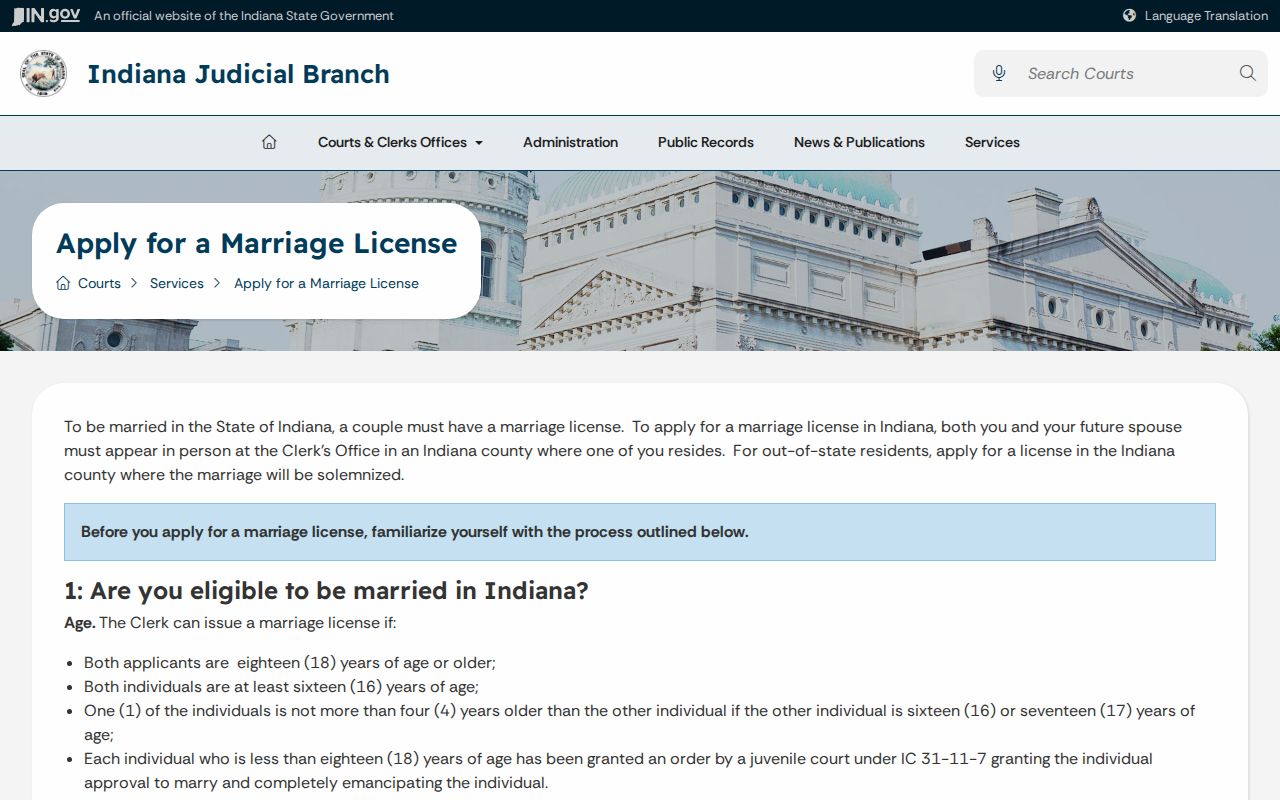
That guidance is the best starting point before checking the issuing clerk's local payment and document practices.
Apply for an Indiana Marriage License
The online application saves intake time, but it is not a license and does not replace the required joint appearance. Confirm the correct county, gather the required proof, and ask the clerk about local payment methods before traveling.
- Select the proper county under Indiana's resident or nonresident rule and locate its clerk.
- Begin the Indiana online marriage application if desired.
- Both applicants appear in person with accepted identity, age, address, and any required prior-marriage documents.
- Review the application, complete the clerk's oath or signature process, and pay the applicable fee.
- Use the license within 60 days, then ensure the officiant returns it to the issuing clerk for recording.
Indiana Marriage Application Fields
Indiana's statewide form collects identity, residence, marital-history, and vital-statistics data for each applicant. Exact labels can change, and a clerk may request added proof. Sensitive fields such as Social Security numbers do not appear in the public lookup.
| Field | Required | Notes |
|---|---|---|
| Legal and intended married names | Yes, as applicable | First, middle, last, and suffix fields |
| Birth and residence details | Yes | Date, place, age, address, county, and ZIP |
| Social Security number | Yes under current guide | Excluded from the public lookup |
| Prior marital history | Yes | Number and date, manner, and place the last marriage ended |
| Parents and statistics | Yes, as applicable | Names, prior surnames, birthplaces, and reporting fields |
| Conditional documents | When applicable | Minor approval or lifetime registrant notice affidavit |
Indiana Marriage and Divorce Fees
Indiana publishes fixed marriage amounts, while divorce filing and certified-decree totals depend on the county, case, copy length, service, and local assessments. Confirm the final amount and accepted payment method with the clerk. Many marriage offices require cash. The IDOH search fee is nonrefundable because it pays for the search by each supplied date, whether or not a matching marriage is located.
| Item | Amount | Where Paid |
|---|---|---|
| Marriage license, resident | $25 | Issuing county clerk |
| Marriage license, two nonresidents | $65 | Issuing county clerk |
| Possible document fee | $4 | Issuing county clerk |
| County certified marriage copy | $4 | Issuing county clerk |
| IDOH marriage search | $8 per date | IDOH Division of Vital Records |
| Divorce filing or certified decree | County quote required | Filing county clerk |
Search Indiana Marriage Records
The free Marriage License Public Lookup can be searched by applicant or spouse name, county, and marriage or license date range. Results may show both names, issue or record dates, the marriage date, and county or license details. It is an index, not a certified copy. Modern electronic coverage is strongest, and the State Archives describes the judiciary portal as covering license information from 1993 forward.
Search first with legal surnames, then test prior surnames, spelling variants, a broader date range, and the likely county. For a license issued before modern coverage, request an index search or copy from the issuing clerk. The Indiana State Archives vital-records guidance explains historical holdings and points researchers toward county and state indexes. A full date and county can make either a county or IDOH request more reliable.
Find Indiana Divorce Records
Search MyCase by either spouse, then narrow by county, court, date, and the DC case type for a dissolution with children or DN for one without children. The public result may supply the cause number, parties, chronological case summary, hearings, rulings, and selected documents. A missing PDF does not mean the decree does not exist. Use the cause number to request it from the filing county's Clerk of the Circuit Court.
A divorce file can include the verified petition, service, provisional orders, financial filings, custody or parenting orders, settlement terms, and final decree. Public access does not extend to every detail. Social Security numbers, account data, children's identifiers, confidential addresses, medical reports, custody evaluations, and protected exhibits may be redacted or excluded. IDOH cannot certify a divorce. Older cases may predate Odyssey and require the clerk's books, microfilm, or transferred archival series.
Order Certified Indiana Records
A certified county copy reproduces the filed license or decree and bears the clerk's certification. IDOH State Form 54764 instead requests a central Record of Marriage search from 1958 forward. The form requires requester details, both spouses' names before marriage, the date and county, purpose or relationship, identification, signature, and payment. It states an approximate six-to-eight-week processing period. Use the current form because payment and identification instructions can change.
- Ask the receiving agency whether it needs the county original, a certified Record of Marriage, or a certified divorce decree.
- Gather full names, prior surnames, event date, county, cause or license number, and identification.
- Send State Form 54764 to IDOH for a covered marriage, or order from the correct county clerk.
- Confirm payment, delivery, and certification needs before submitting the request.
Indiana Vital Records Marriage Service
The Indiana Department of Health Division of Vital Records maintains the central marriage record series beginning in 1958. Its marriage form offers a certified copy when a supplied record is found. It is not a general divorce index and has no divorce decrees. Marriage records before 1958 go to the county clerk. The form requires identification and describes its fee as a search charge, so accurate names, date, and county matter.
The assigned IDOH marriage-record source shows the state request route.
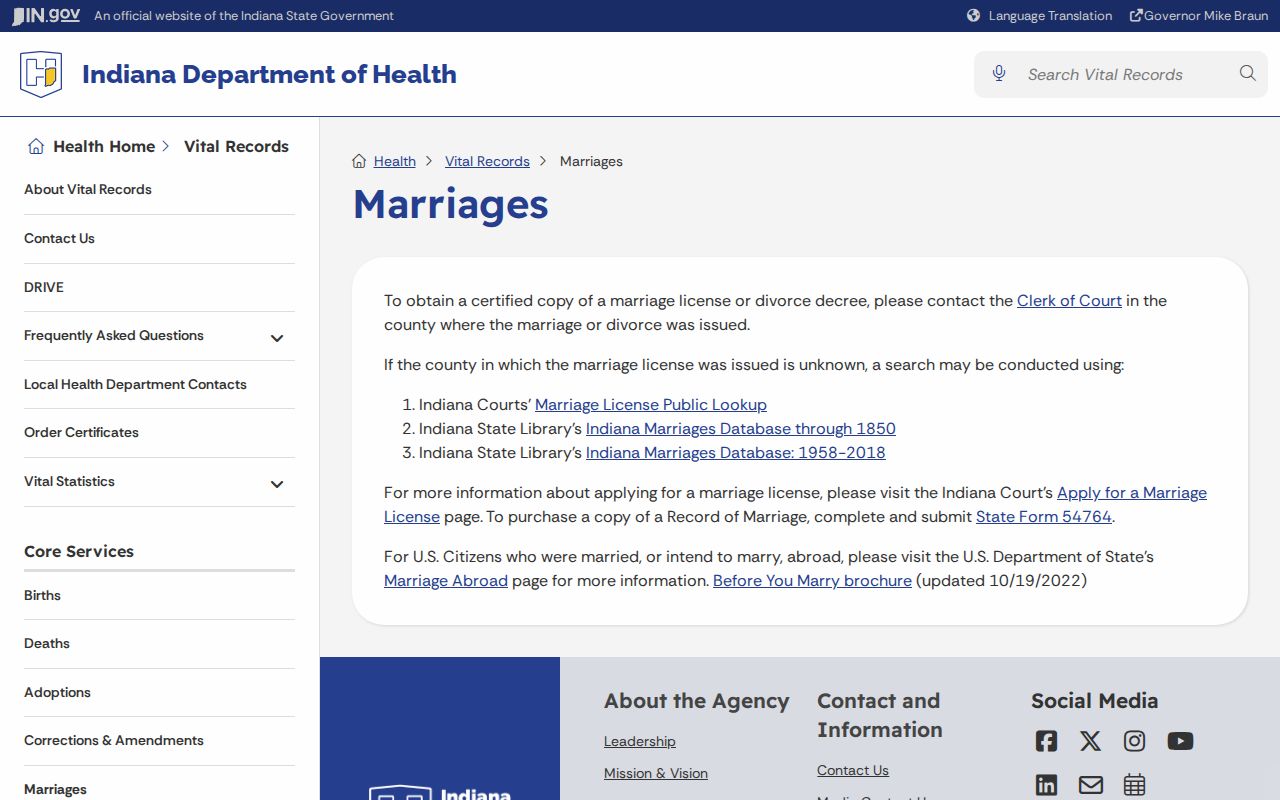
Its statewide service complements, but does not replace, the county clerk who holds the original record.
State versus county: IDOH searches covered marriage records. The county clerk supplies the original marriage record or any divorce decree.
Indiana Department of Health, Division of Vital Records
Attn: Marriage
2 North Meridian Street
Indianapolis, IN 46204
Find an Indiana County Clerk
Indiana uses a unified Clerk of the Circuit Court rather than separate county and district clerks. Identify the county that issued the marriage license or granted the divorce, then use the directory of all 92 Indiana counties. Ask that clerk for the exact license, returned marriage record, case pleading, order, or certified decree needed. For a historical file, also ask whether the record remains in local books or microfilm or has transferred to the Indiana State Archives.