
Search Indiana Court Records Online
MyCase is Indiana's free public search for cases recorded in the Odyssey case-management system. It covers migrated trial courts and appellate case data, but coverage began on different dates for different courts. The official Odyssey coverage list shows each court's go-live date. A missing result does not prove that no case exists. Older indexes, paper jackets, microfilm, and documents withheld from anonymous online viewing can remain with the local clerk.
Gather the cause number, party's recorded name, likely filing county, and a useful date range. Name variants matter. MyCase supports wildcards and a Sounds Like option, while a date of birth can narrow a person search even though it is not shown in the public result. Broad searches return no more than 1,000 results, so a court, case type, status, or filing-date filter can make a common-name search workable.
- Open MyCase and choose Search by Case, Party, or Attorney.
- Enter one case identifier, or use a last name with a first name, middle name, or birth date.
- Narrow results by court, case type, open or closed status, and filing dates when needed.
- Open the case and read the newest Chronological Case Summary entries, not just the header status.
- Ask the filing clerk for a missing document or a certified copy after confirming the exact document and fee.
The Indiana judiciary's MyCase search tips explain identifier formats, wildcard use, and filter behavior. Search results are leads to the record, not substitutes for a clerk-certified order.
The judiciary's MyCase instructions are also the source of the portal view pictured below.
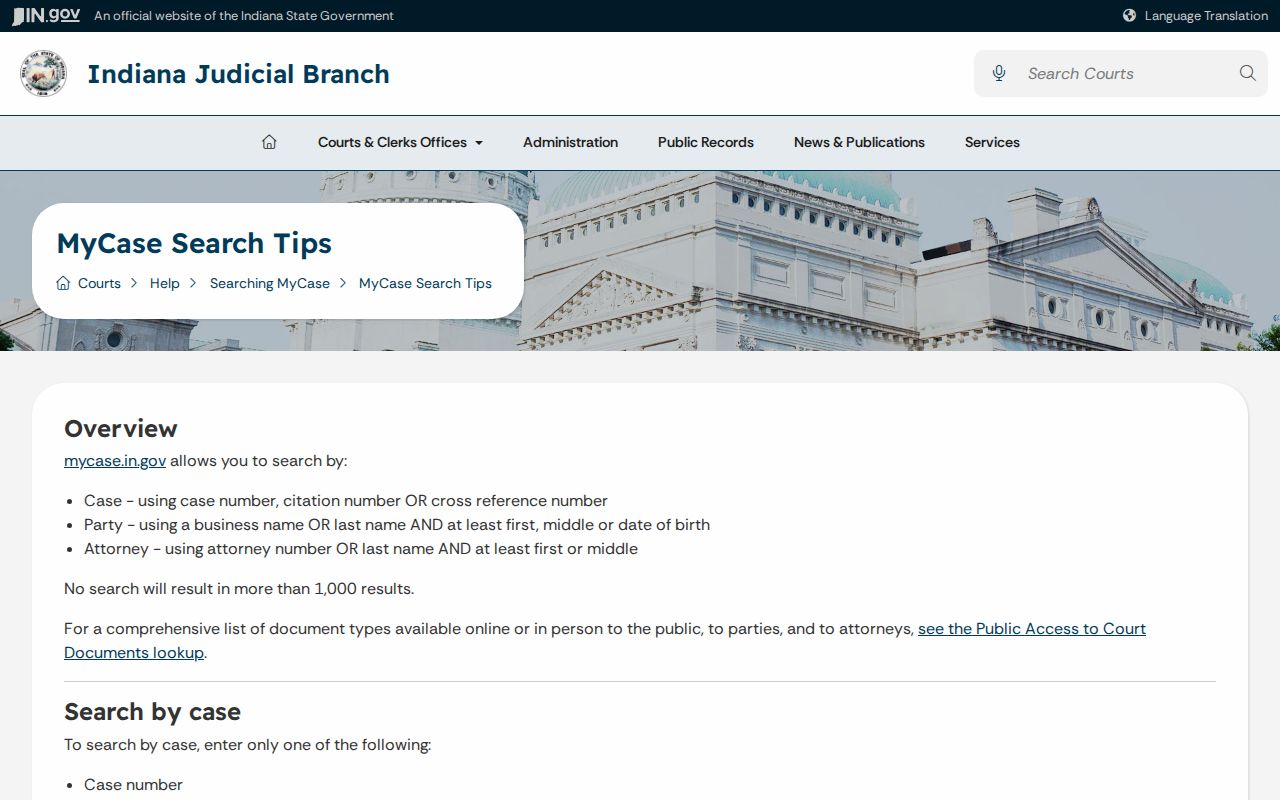
The image reinforces why the statewide portal is the sound first stop before a request goes to a local clerk.
Indiana Court Record Search Fields
MyCase separates identifier, party, and attorney searches. Only one identifier is used on the case tab. Party searches accept a natural person or business, and attorney searches accept a roll number or name. These core controls reflect the statewide form.
| Field Label | Type | Required | Notes / Format |
|---|---|---|---|
| Case, citation, or cross-reference number | Text | One for case search | Use one identifier; case numbers may omit hyphens and leading zeroes. |
| Last, first, and middle name | Text | Last plus another key | Wildcard and Sounds Like can address spelling differences. |
| Date of birth | Date | No | Narrows a person search but does not display publicly. |
| Business name | Text | Yes on business route | A trailing wildcard helps when a suffix varies. |
| Attorney name or number | Text | One attorney route | The number is the Indiana roll number. |
| Court and case type | Dropdown | No | Case-type choices change with court selection. |
| Status and file dates | Dropdown / dates | No | Filter open or closed cases and a filing period. |
A uniform Indiana cause number contains the county code, court identifier and number, filing year and month, case type, and sequence. For example, an F6 segment marks the case type at filing. It does not establish that anyone was convicted of a Level 6 felony.
Types of Indiana Court Records
Indiana Circuit and Superior Courts create most trial records. Local caseload plans distribute work among judges, so the words circuit and superior alone do not reveal the subject of a file. City and town courts keep authorized traffic, ordinance, infraction, and misdemeanor cases. Probate usually sits within a Circuit or Superior Court division, with separately named probate courts in two counties. Appellate records are maintained through a separate statewide appellate clerk.
Case type controls what documents and access limits apply. The main Indiana court record groups include:
- Civil files with complaints, service, motions, orders, judgments, garnishments, and satisfactions.
- Criminal files with charging papers, bond orders, pleas, rulings, dispositions, sentences, and later probation events.
- Domestic-relations files involving divorce, custody, support, paternity, and modification, with protected family data removed.
- Probate, estate, trust, and guardianship files, including wills, inventories, claims, accountings, and closing orders when public.
- Traffic, infraction, and ordinance files showing the citation, plea, judgment, costs, payment events, and agency transmission.
- Appeals with notices, briefs, record and transcript events, opinions, transfer requests, and mandates.
Juvenile, adoption, and mental-health proceedings also create court records, but public access is much narrower. A requester should name the case type and document rather than ask a clerk for every record connected to a person.
The Indiana judiciary's statewide court forms collection illustrates the range of filings that can enter these case types.
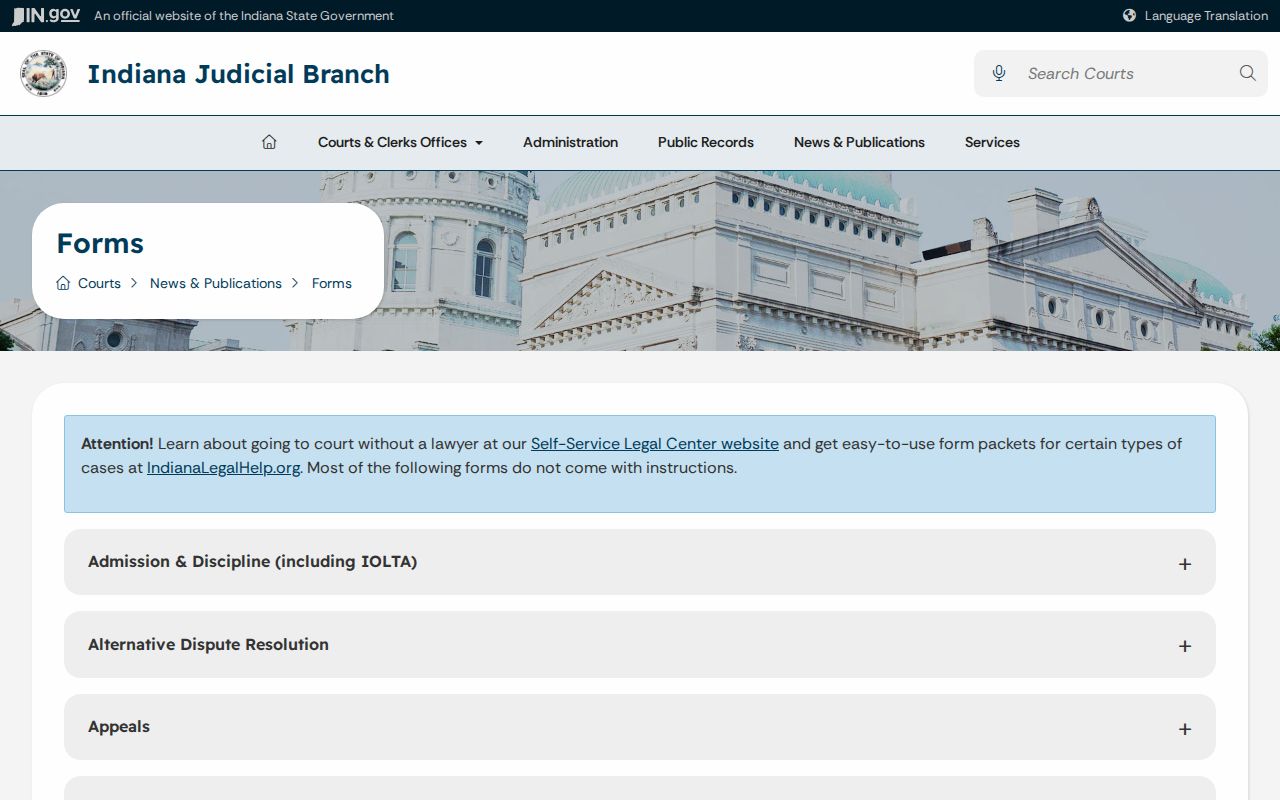
Those forms help identify a filing by its proper name, which makes a county copy request more precise.
What Indiana Court Records Show
A MyCase detail page combines a case header with parties, counsel, hearings, financial events, documents, and the Chronological Case Summary, or CCS. A field can describe the whole case or only one count. Read them separately. An open or closed label is an administrative state, not a ruling on guilt or liability, and an online balance is not always the clerk's current payoff.
| Field | What It Shows |
|---|---|
| Cause number and court | Filing venue, court identifier, filing period, case type, and sequence. |
| Caption and parties | Names and roles such as plaintiff, defendant, petitioner, or respondent. |
| Attorneys and judicial officer | Entered counsel and assigned judge or magistrate. |
| CCS events | Dated filings, service, hearings, orders, dispositions, payments, and appeal steps. |
| Charges or claims | Count, description, statute, severity, and current or final status when recorded. |
| Hearings | Date, time, type, location, and judicial officer, subject to later reset. |
| Documents | Links to selected public filings; a docket entry does not ensure a PDF is public. |
| Financial data | Assessments, payments, balances, fines, costs, or restitution when configured. |
Document status deserves care. A proposed order is not an entered order. A plea agreement is not a conviction. A notice of appeal is not a reversal. Check the file date, title, filer, and later CCS entries, then obtain the entered judgment or order when the legal outcome matters.
Indiana Court Records Access Rules
The Indiana Rules on Access to Court Records begin with public access and then identify excluded information and role-based access. Indiana Code 5-14-3, the Access to Public Records Act, covers public-agency records but recognizes the Supreme Court's authority over judicial records. Administrative Rule 9 governs court-record administration and bulk dissemination. A one-case clerk request is different from a bulk-data request.
Anonymous users can inspect public MyCase data without a fee. A party or attorney may connect verified credentials for broader access to eligible documents, but those roles do not defeat every exclusion. If a public filing is not online, anyone may ask the correct clerk to inspect or copy it. Certified and exemplified copies carry added authentication. Indiana charges combine statutory and local components, so the requester should obtain a quote for pages, certification, postage, and delivery before sending payment.
Note: MyCase is free, but an online summary is not a certified copy and may omit otherwise public attachments.
The judiciary's public-access handbook and FAQ explain the court-specific framework shown in the next image.
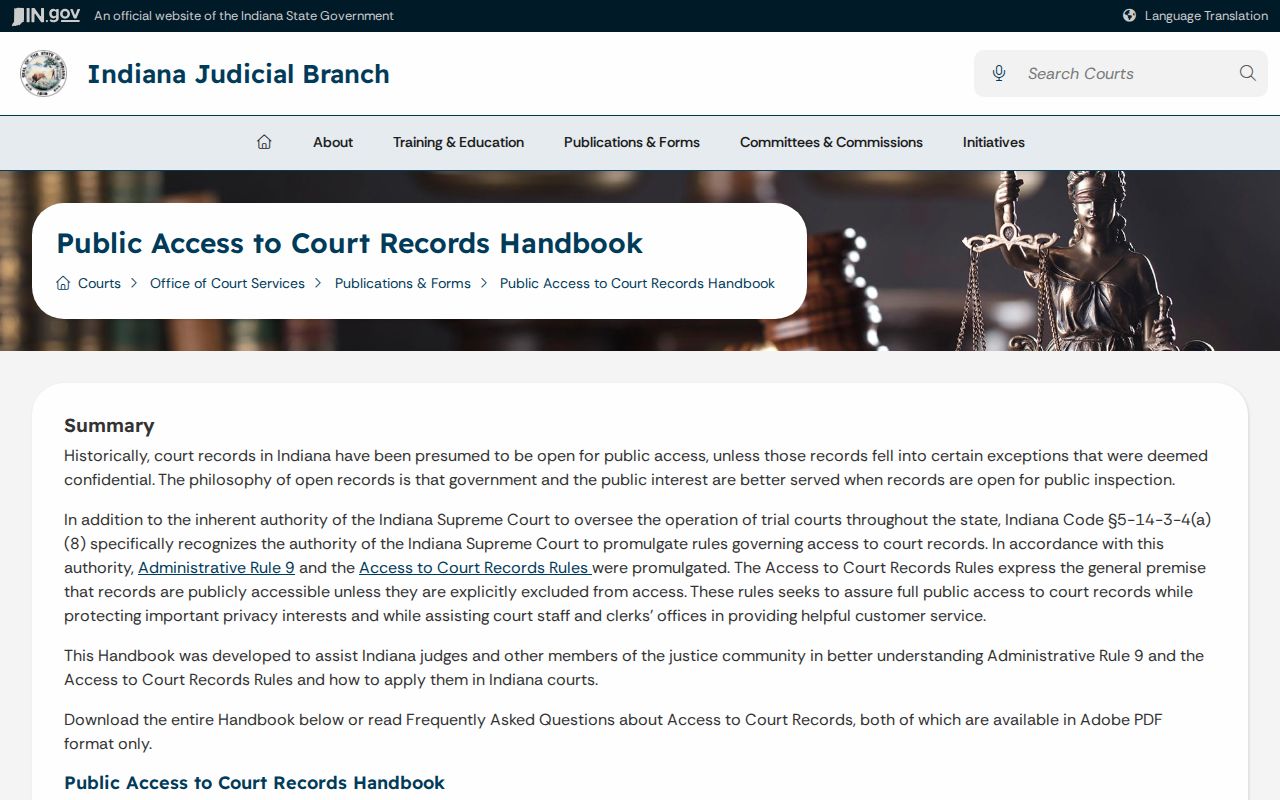
That framework directs case-file questions to the judicial custodian rather than treating every request as an ordinary agency-record demand.
Restricted Indiana Court Records
Public access does not include every field or file. Adoption records are confidential. Juvenile access depends on the proceeding, allegation, age, statute, and requester's role. Mental-health case material and medical evidence are restricted. Full Social Security and account numbers, full birth dates, protected addresses, and designated information about minors or victims must be redacted or excluded. Grand-jury material, protected informant information, and sealed warrant material may also remain unavailable.
Indiana Code 35-38-9 provides paths to restrict eligible arrest, charge, and conviction records. Eligibility and waiting periods differ by outcome and offense. A petition goes to the court and county tied to the history. If granted, the clerk sends the order to repositories and agencies, but specified justice actors can retain lawful access. Expungement restricts access; it does not necessarily destroy every record or cure a private copy made before the order.
When access is denied, ask whether the record is excluded, redacted, sealed, or merely absent online. Those are different answers. The Access Rules provide a judicial review route, while an agency APRA dispute may be taken to the Indiana Public Access Counselor.
Find an Indiana Court Clerk
Indiana uses a unified Clerk of the Circuit Court in each county for Circuit, Superior, and local probate case files. City and town courts may have separate clerks, so the issuing court printed on a citation or the court named in a cause number matters. Start with the Indiana county directory, then confirm the office through the judiciary's local court and clerk directory. The site's Indiana clerks overview explains copy and certification channels.
A useful written request identifies the county, court, cause number, caption, exact document, filing or event date, plain or certified status, delivery method, and a maximum approved cost. Ask about payment before mailing funds. For legacy records, mention the approximate year and party name so staff can check indexes, microfilm, or transferred archives. Clerk staff can locate records and describe procedure, but they cannot provide legal advice or decide which document will satisfy another agency.
Note: A cause number is the best routing key because it identifies the filing county and court as well as the case type.