
Indiana Court Dockets and CCS
Indiana calls the official event log the Chronological Case Summary, commonly shortened to CCS. It lists actions in date order: filing, service, appearances, motions, hearings, orders, disposition, money events, and appeal activity. The CCS is the docket. It is not the complete collection of pleadings, exhibits, transcripts, and signed orders. A line stating that a motion was filed confirms an event, while the motion itself may be a separate document that is downloadable, available only at the clerk's counter, or excluded from public access.
The elected Clerk of the Circuit Court maintains trial dockets for Indiana Circuit, Superior, and probate courts in the filing county. A city or town court may use its own clerk. The statewide appellate clerk maintains Supreme Court, Court of Appeals, and Tax Court records. This office structure matters when a public MyCase docket does not include the actual filing a requester needs.
Search Indiana Court Dockets Online
MyCase publishes public docket data from courts using Indiana's Odyssey system. Each court migrated on its own date, so the Odyssey court coverage list is essential for older cases. Archived cases from abolished courts can appear, yet a pre-migration case may be absent or incomplete. No result should lead to a coverage check and clerk inquiry, not a claim that no proceeding exists.
Use a cause number when possible. A party search requires a last name plus a first name, middle name, or date of birth. Wildcards and Sounds Like can help with spelling. Court, case type, status, and filing dates reduce large result sets. MyCase caps results at 1,000, which makes focused criteria important for a common name.
- Choose the Case, Party, or Attorney tab in MyCase.
- Enter the cause number without hyphens if needed, or provide the required name fields.
- Filter the court, case type, status, or filing period to narrow results.
- Open the correct case and review the CCS from the first entry through the newest event.
- Confirm a near-term hearing or deadline directly with the court.
The public docket updates as judges and clerks enter events. A recent reset, warrant return, payment, or release may not be safe to judge from a browser page alone. When attendance, liberty, or a deadline is at stake, call the court or custodial office.
Read Indiana Court Docket Entries
A CCS line should be read as one dated action, then checked against later entries. The entry may name the filer or judicial officer, summarize the action, and provide a public document icon. It may also carry financial data. An assessment is not always the current payoff, and a proposed order is not an entered order. These core fields help separate a docket event from its legal effect.
| Field | What It Shows |
|---|---|
| Entry date | When the clerk recorded the filing, hearing, order, service, payment, or other event. |
| Event description | The docket label and summary, such as appearance filed, hearing held, order entered, or case dismissed. |
| Filer or judicial officer | The party, lawyer, judge, or magistrate associated with the event when populated. |
| Hearing data | Date, time, type, court or location, and assigned officer, subject to later changes. |
| Document icon | A link to an eligible public filing, not a promise that every noted document is online. |
| Financial event | Assessment, receipt, payment, fine, cost, restitution, or balance data when configured. |
| Disposition entry | The result of a claim, charge, or case, which can differ across individual counts. |
Common Indiana labels include CCS for the docket, FTA for failure to appear, and case-type codes such as F1 through F6 for felony levels, CM for criminal misdemeanor, IF for infraction, PL for civil plenary, and SC for small claims. Administrative Rule 8 is the current authority for cause-number and case-type codes. Codes have changed over time, so the date and full text remain important.
Indiana Courts Publishing Dockets
MyCase is the common public layer, but legal custody follows the court. The system covers active Odyssey courts and appellate data from the relevant statewide migration period. Online depth depends on the court, case age, document category, and public-access role. Indiana's main docket sources are:
- Circuit and Superior Courts, which create most county civil, criminal, family, juvenile, probate, and small-claims CCS records.
- Separately named probate courts and probate divisions, whose public case events can appear through Odyssey.
- City and town courts, which handle authorized ordinance, infraction, traffic, and misdemeanor matters and may require their own clerk.
- Indiana appellate courts, whose filings, orders, briefing events, opinions, rehearing, transfer, and mandate activity use the statewide appellate clerk.
- The Indiana Tax Court, a statewide specialized court for original tax appeals.
The Indiana appellate clerk's filing information shows the appellate channel captured in the assigned image.
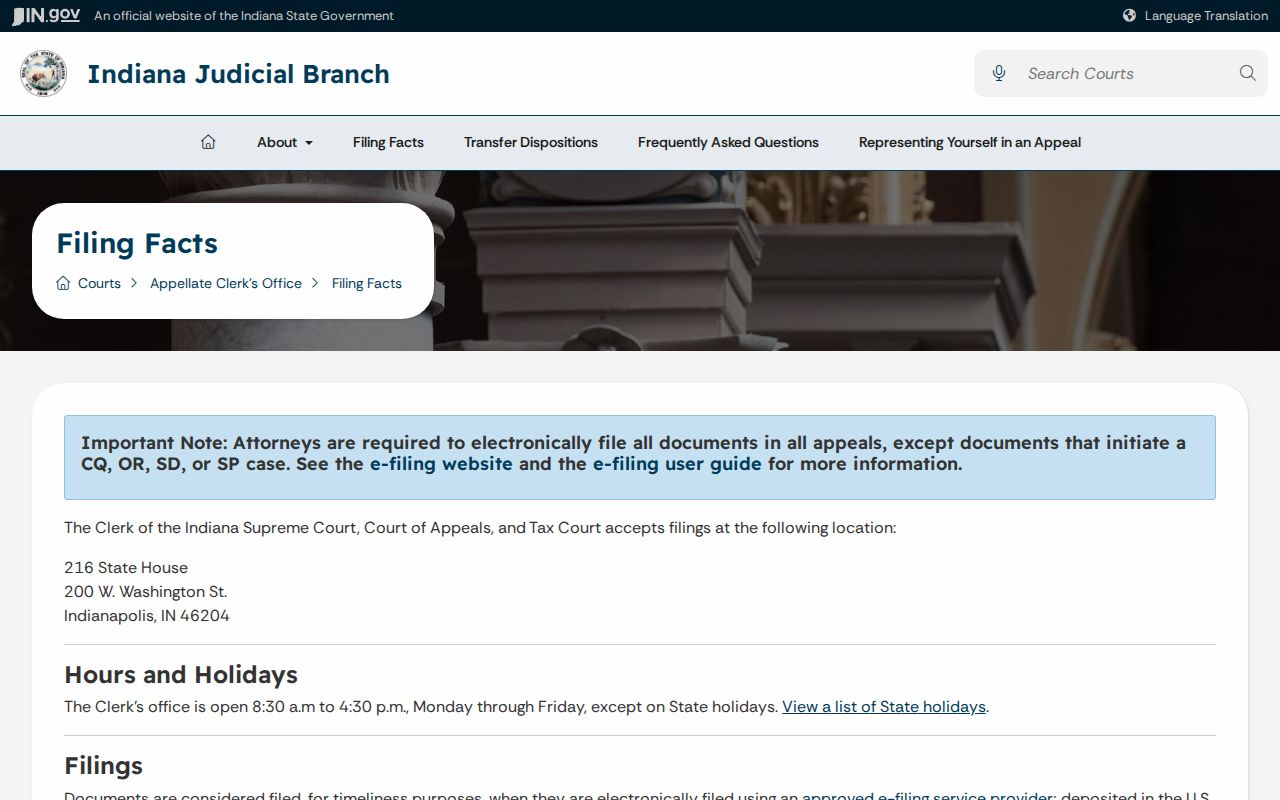
The appellate route is distinct from asking a county clerk for the trial-court record that went up on appeal.
Indiana Docket Versus Case File
The CCS is an index and event history. The case file holds the underlying papers. MyCase may place a public PDF beside an entry, but an absent icon does not prove that a public paper is unavailable at the clerk's counter. Conversely, an event listed in the public docket does not make every related exhibit, report, or confidential attachment available.
| Docket | Full Case Record | |
|---|---|---|
| Format | Dated CCS entries | Pleadings, orders, notices, exhibits, and other filed material |
| Best use | Track procedure and locate key dates | Read the actual allegation, argument, evidence, or ruling |
| Public access | Often free in MyCase | Selected PDFs online; other public items from the clerk |
| Certification | Certified docket from custodian when required | Clerk-certified copy of the specific filing or order |
| Main caution | A summary line can lack detail | Some documents are sealed, redacted, or excluded |
A transcript is another distinct product. A court reporter prepares requested transcript material for appeal and may require a deposit based on estimated cost. It should not be assumed that hearing audio or a verbatim transcript sits behind a CCS entry.
Interpret Indiana Docket Status
Start with the case header, but do not stop there. Open and closed describe case administration. A closed criminal case may still show probation or an unpaid balance. An open case may include a dismissed count while another remains pending. In civil matters, closure may follow settlement or dismissal without a public damages finding. Read each count or claim and the newest relevant order.
Disposition language must remain exact. Filed or pending is an allegation. Dismissed means that count ended without conviction, though with-prejudice language and later refiling can matter. Acquitted or not guilty means the factfinder did not convict. A guilty plea or finding supports a conviction only when entered by the court. A continuance moves a setting; it does not resolve the case. A notice of appeal begins review but does not reverse the judgment.
Note: A hearing line may be superseded by a later reset, so verify the newest CCS entry and contact the court before attending.
Indiana Dockets by Case Type
Criminal CCS entries may show a charging information, probable-cause finding, warrant or summons, arrest return, initial hearing, counsel, bond, pretrial conference, motion, plea hearing, trial, judgment, sentencing, probation, revocation, and appeal. Police discovery and presentence reports are not automatically public docket attachments. A booking label from a jail is not the same as the filed charge shown in the criminal case.
Civil and family dockets follow different paths. A civil file can show complaint, summons and return, appearance, answer, motion, mediation, trial, judgment, garnishment, and satisfaction. A domestic-relations docket may add provisional orders, custody or support events, a settlement, decree, contempt, and modification. Protected financial, medical, minor, or address information may be absent even when the case's existence is public.
On appeal, look for notice of appeal, appearance, completion of the clerk's record, transcript notices, briefing, oral argument, decision, rehearing, transfer petition, and mandate. The mandate returns authority to the trial court, where later action may appear on the county CCS.
Get an Indiana Certified Docket
A certified docket or missing filing comes from the custodian. Use the Indiana county directory for a trial case and identify the exact Circuit, Superior, probate, city, or town court. Give the cause number, caption, date range, requested CCS or document, certification level, and delivery method. Ask the clerk to quote page, certification, postage, and any local charge. MyCase search is free, but copy and certification charges are separate.
For a legacy case, cite the approximate year and party names and ask about index books, microfilm, paper jackets, or State Archives transfer. For an appellate docket, use the statewide appellate clerk rather than the trial clerk. A narrow request is faster and less costly than asking for every paper in a long file.
If a CCS entry appears wrong, first save the cause number, event date, label, and any linked file. Contact the filing clerk because that office controls the trial docket. A statewide search service cannot independently rewrite the local court's official entry. If the dispute concerns what a police agency, jail, or criminal-history repository reports, send the certified court disposition to that separate custodian and follow its correction channel.
Requesters seeking an official financial balance should also call the clerk. Assessments, receipts, restitution allocations, collections, interest, refunds, and bond disposition can change after the public event shown online. A docket is useful for finding the relevant order and payment events, but the clerk's current accounting is the proper source for a payoff or formal balance.
Note: The cause number is the strongest request key because it encodes the filing court, period, case type, and sequence.