
Indiana Has No Complete Warrant Index
Indiana courts and law-enforcement agencies exchange warrant data through electronic justice networks, but those agency systems are broader than anything open to anonymous public users. MyCase can show public chronological case summary entries such as warrant issued, returned, served, recalled, or quashed. It is not an authoritative statewide clearance search. A sealed warrant, a lower-court record outside Odyssey, an unserved search warrant, or a recent entry awaiting data processing may be absent.
Warrant authority remains tied to a particular case and issuing court. Circuit and superior court judges issue criminal and probation-related orders, while city and town courts may issue bench warrants in matters within their jurisdiction. County sheriffs execute or maintain information about many local warrants. A public list from one sheriff covers that office, not all Indiana counties. Likewise, a selective most-wanted page does not prove that a person without a listing has no warrant.
Important: A name match or old issuance entry is not proof of a currently outstanding Indiana warrant; confirm identity and the newest signed court action.
Indiana Warrant Types
The reason for an Indiana warrant shapes both public access and the safest verification route. An arrest warrant starts a custody process based on an alleged offense. A bench warrant grows out of an existing case, often after a missed appearance or failure to comply. Search warrants focus on evidence rather than requiring a defendant to appear. Other orders address supervision, extradition, or civil enforcement.
- Arrest warrant: a judge authorizes an arrest after a finding of probable cause for an alleged offense.
- Bench warrant: a court orders custody for failure to appear, contempt, release violation, probation violation, or disobedience of an order.
- Search warrant: a judge authorizes a defined search or seizure; the application and affidavit may remain sealed during an investigation.
- Fugitive or extradition warrant: the order supports custody and return across jurisdictional lines.
- Civil body attachment: a court uses custody as an enforcement tool in certain civil proceedings; it is not automatically a new criminal charge.
Terminology matters. An issuance event records that the court acted at that point in time. Service means the order was executed. Recall or quash means the court later withdrew it. A historical issued entry may stay visible after a later recall, so readers must follow the case chronology through the latest event.
Search Indiana Warrant Records
Start with exact identity and venue facts: full legal name, date of birth when lawfully available, cause or citation number, likely issuing court, and every county connected to the alleged offense, residence, work, or citation. Search the public case history, then verify with local custodians. One source rarely answers the full question.
- Search MyCase by name or exact cause number. Open likely cases and read the newest chronological entries, not merely the first reference to a warrant.
- Identify the issuing court. Contact its clerk with the cause number and ask whether the docket shows issuance, service, recall, or quash.
- For a city or town court matter, contact that court directly. Its original file may not be maintained by the county circuit clerk.
- Contact the county sheriff warrant division or non-emergency line through the official county site. The agency may limit telephone confirmation.
- For a serious charge, unclear bond, probation matter, or surrender question, ask Indiana defense counsel to verify the order and court process.
- After court action, obtain the signed order or updated chronological case summary and confirm that the serving agency received the change.
The official Floyd County clerk page illustrates how a local Indiana clerk connects court records, payment, and MyCase channels.
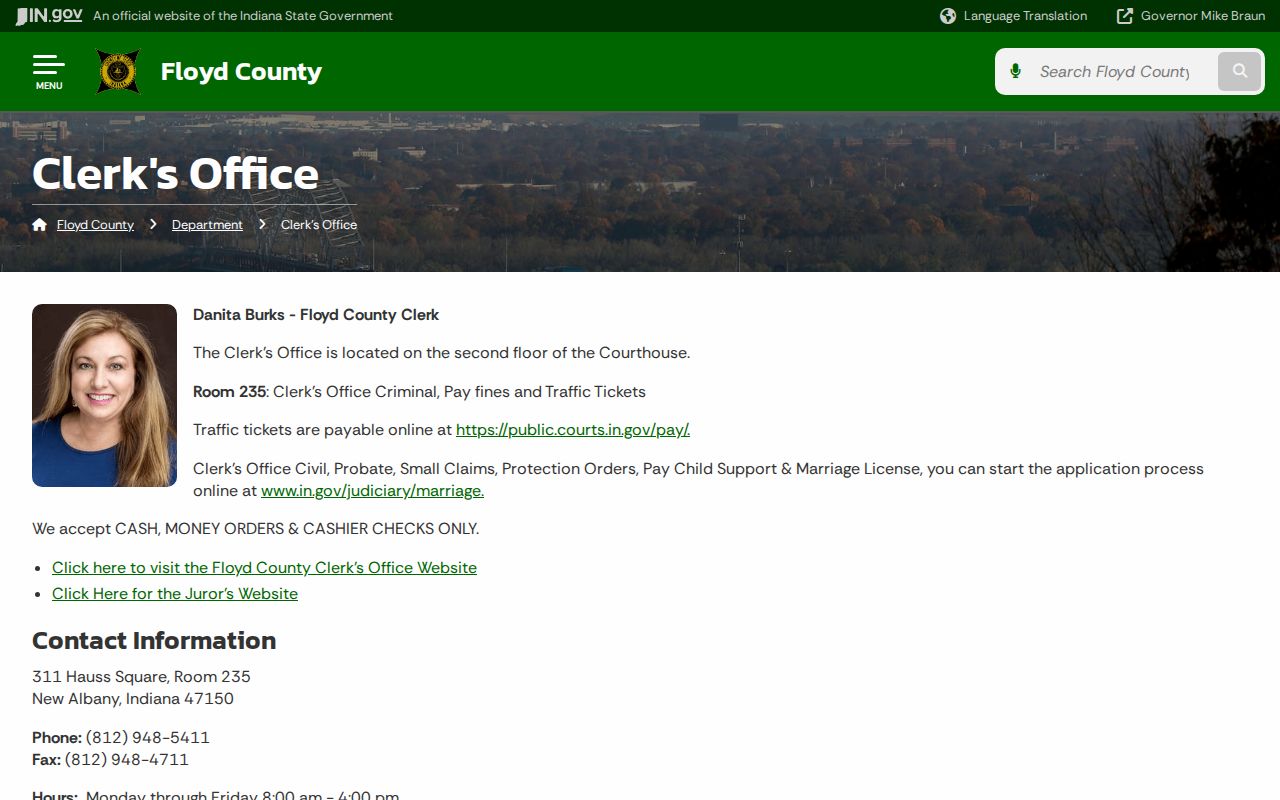
That local example reinforces the statewide rule: the clerk for the actual issuing court is the source for its docket and signed orders.
Indiana Warrant Search Inputs
Indiana has no mandatory statewide public warrant form, so there is no single set of required fields. MyCase and local offices use the following details to narrow a search. Never treat a partial name match as confirmed identity.
| Input | Use | Key Limit |
|---|---|---|
| Full legal name | Find likely public court cases | Aliases and common names can create false matches |
| Date of birth | Distinguish people with similar names | Not shown or accepted in every public channel |
| Cause or citation number | Reach the exact court file | Must match the issuing court's record |
| County and court | Identify the clerk and sheriff | More than one venue may need checking |
| Event date | Help staff locate an older or recent entry | Issuance date does not establish current status |
What Indiana Warrant Records Show
A public Indiana case entry can identify the case and record the warrant's procedural history. It does not reveal every item used by law enforcement. National warrant identifiers, officer-safety notes, protected addresses, informant information, sealed affidavits, and tactical details ordinarily remain outside the public result.
| Public Field | What It May Show |
|---|---|
| Defendant and cause number | The named party and unique Indiana court case identifier |
| County and court | The issuing venue and correct clerk for confirmation |
| Charge or basis | The alleged offense, failure to appear, probation issue, or other stated reason |
| Issue date and event text | When the order was entered and how the docket labels it |
| Bond terms | Amount or type if the court made those terms public |
| Service or return | Whether the order was executed and returned to court |
| Recall or quash order | A later court action withdrawing the warrant |
| Next hearing and counsel | Scheduled court activity and attorney information when public |
Bond information is not a release promise. Another county warrant, probation hold, extradition matter, or other detainer can still control custody even when one case displays bond.
Restricted Indiana Warrant Material
Search-warrant records follow a different public-access timeline. The application, probable-cause affidavit, signed warrant, return, inventory, and later suppression litigation may become court records, yet early disclosure can expose an investigation or protected person. Juvenile warrants and protected identities are confidential. Domestic-violence cases may also shield addresses. Indiana's Rules on Access to Court Records govern judicial-record exclusions and role-based access.
The Indiana judiciary's Protection Order Registry guidance shows another electronic court and law-enforcement system whose agency access is broader than public access.
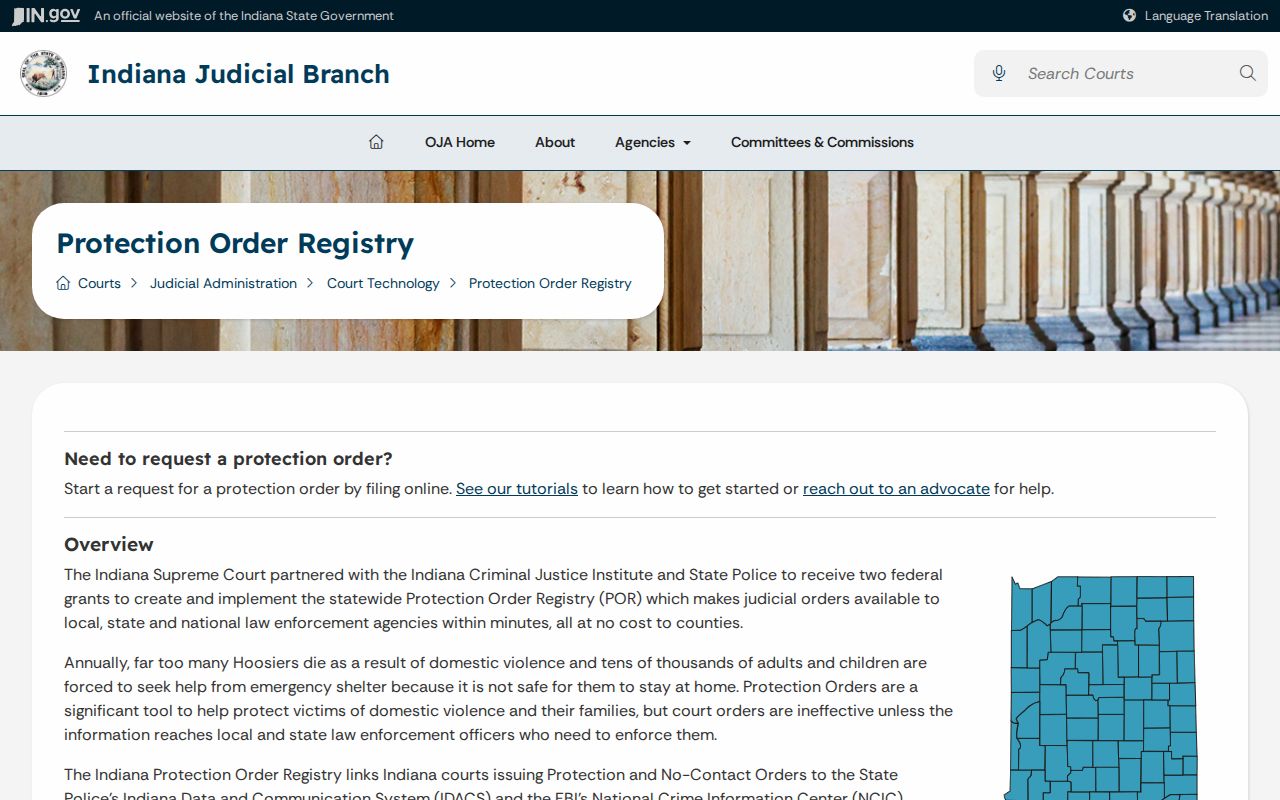
A protection order is not a warrant, but the registry demonstrates why access to public court data and access for authorized justice users must not be treated as equal.
Qualifying arrest, charge, or conviction records may be restricted under Indiana Code 35-38-9. A restricted case may disappear from ordinary public view while remaining available to specified agencies. Absence from a public search therefore cannot certify that no justice-system record exists.
Resolve an Indiana Warrant Safely
Do not rely on a payment screen, a stale most-wanted list, or a single case entry. For a felony, misdemeanor, probation, extradition, or uncertain bond matter, an Indiana defense lawyer can contact the court and prosecutor, obtain documents, plan a voluntary appearance, and request bond review where allowed. Court clerks can explain filing and scheduling procedure, but they cannot advise whether surrender is strategically wise.
Ask whether the warrant specifies cash, surety, recognizance, judicial review, or a hold without stated bond. Counsel may seek recall or quash, but no statewide amnesty automatically clears Indiana warrants. Local compliance programs and enforcement notices are dated and court-specific. Only a signed and entered court order changes status. Paying a balance alone may not recall the warrant until the court acts.
After any appearance, obtain the chronological case summary and signed order. Check MyCase after clerk processing and confirm with the issuing agency if instructed. If the record is wrong, correction begins with the source that entered it. A clerk addresses a court entry through court procedure; a sheriff addresses its agency data after receiving the controlling order.
Note: Emergency threats belong with 911, but routine Indiana warrant verification should use the issuing court, official sheriff channel, or counsel.
Find Indiana Warrants by County
Use the Indiana county directory to reach the county connected to the offense, citation, former address, work location, or other likely venue. Indiana has 92 county court systems, and more than one may need to be checked. The issuing court's clerk controls its docket and orders, while the sheriff can explain local warrant-service and confirmation practice.
A written agency request can help when a sheriff does not publish a roster or when a historical, publicly disclosable record is needed. Describe the person, likely date, issuing venue, and requested public fields with care. The Indiana Access to Public Records Act applies to agency records, but it does not force disclosure of active-investigation material, sealed warrant papers, security information, or data the agency does not maintain. It is also too slow for an urgent liberty question. Ask for a written basis when access is denied, and use the court access process for judicial records rather than sending the same request to every agency.
If the case began in a city or town court, follow the court printed on the citation or shown in the case entry. A circuit clerk may not hold that lower court's original file. For the filed allegations and later disposition after arrest, review the separate Indiana arrest and court charge record process. Warrant status itself still requires direct verification with the issuing venue.